
OAuth Deception in the UAE: The Hidden Vendor Risk Behind Enterprise Access


- 1. Executive Intelligence Report: The Supply-Chain Proxy
- 2. Search Intent Intercept: The Technical Reality of Token Hijacking
- 3. Field Observations: The Anatomy of the “Enterprise RFP” Deception
- 4. The Architecture of Denial: Deconstructing Agency Deflections
- 5. Search Intent Intercept: The UAE Legal Guillotine
- 6. Overcoming Boardroom Friction
- 7. The AELION Protocol: Zero-Trust Governance
- 8. Verified Intelligence Sources
Intelligence Briefing: The Supply Chain Trojan – How UAE Agencies Fall for OAuth Deception
1. Executive Intelligence Report: The Supply-Chain Proxy
The UAE market now has a supply-chain proxy problem.
The agency is no longer near the attack. It is inside the trust path.
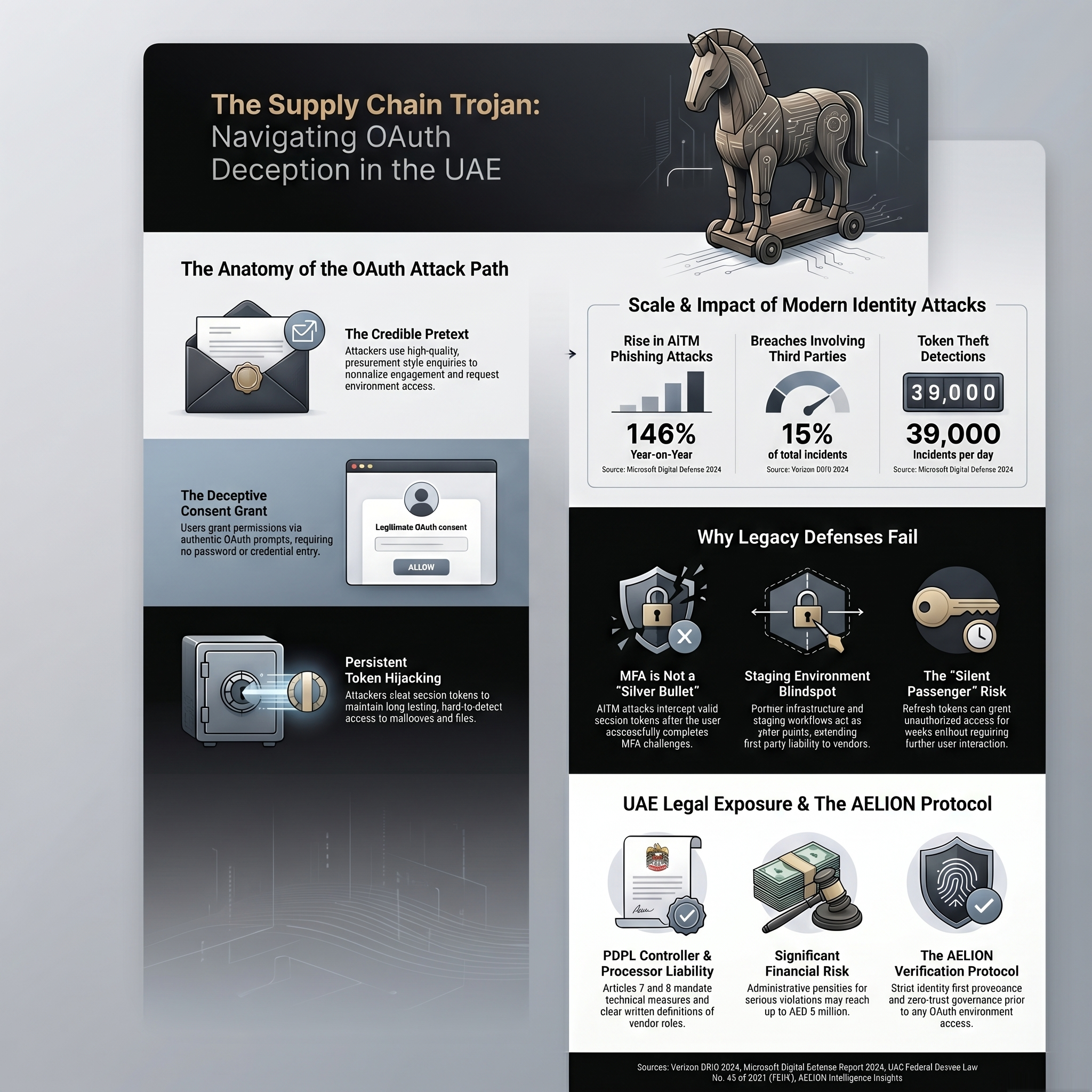
Microsoft states that AiTM phishing attacks rose 146% year on year, with platforms catching 39,000 incidents per day. PwC’s Middle East findings also note that 92% of organisations surveyed by Proofpoint in the UAE reported at least one successful phishing attack in 2023. This is the operational shift: third-party risk now behaves like first-party liability. (Microsoft Learn)

The weak point is not always the client tenant. Often it is the delegated vendor, the staging workflow, the shared mailbox, the consent screen, or the external app already placed inside a trusted process. Verizon reports that 15% of breaches involved a third party. PwC reports that 34% of regional respondents said they were least prepared to address third-party breaches over the next 12 months. (Verizon)

2. Search Intent Intercept: The Technical Reality of Token Hijacking
How does OAuth consent phishing work?
A malicious actor sends a link to a consent screen for a third-party application. The user signs in through a legitimate identity provider and clicks Accept. No password theft is required. Microsoft states that this can grant long-lasting, hard-to-detect access if a malicious app receives delegated permissions. (TECHCOMMUNITY.MICROSOFT.COM)
How does AiTM phishing bypass MFA in Microsoft 365?
It does not defeat MFA mathematically. It defeats it operationally.
The attacker proxies the live sign-in flow, waits for the user to complete MFA, then captures session cookies or tokens issued after authentication. Microsoft’s Entra guidance states that AiTM can capture sensitive information and bypass multifactor authentication because the attacker rides the valid session after the user completes the challenge. (Microsoft Learn)
What is a refresh token, and why does it create persistent access?
It is the silent passenger.
Microsoft’s Entra guidance states that sign-in session tokens, including refresh tokens, can last for weeks or months and can enable persistent unauthorised access if stolen. That is why token theft is quieter than password theft. The compromise can remain active after the original sign-in moment has passed. (Microsoft Learn)
The illusion of custom domains
A branded address is not the same as sovereign control.
Google documents that organisations can run mail for @your-company through Google Workspace by directing mail records to Google while preserving the company address format. The domain looks private. The trust boundary is still external. (Microsoft)
3. Field Observations: The Anatomy of the “Enterprise RFP” Deception
These approaches do not arrive like obvious fraud.
They arrive like procurement.
Budget is credible. Tone is measured. Documentation is present. Urgency is absent. Access is framed as normal due diligence.
- Incident A — Victoria: A commercially credible Saudi-based enquiry used requirements documentation to normalise the engagement while refusing standard identity verification and retaining channel control.
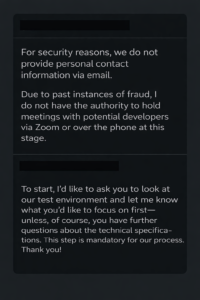
Redacted incident evidence from the Victoria approach, showing refusal of standard identity verification followed by pressure to inspect a test environment as a mandatory next step.
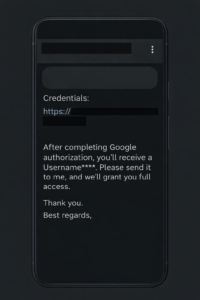
- Incident B — Sophia: A commercially credible consumer-products pretext advanced towards a weaponised development path, including
/dev-admin/, and explicitly required Workspace authorisation for access. -

Redacted incident evidence from the Sophia approach, showing the transition from a commercially credible enquiry to a Google authorisation and access request.
4. The Architecture of Denial: Deconstructing Agency Deflections
When compromise happens, lower-tier vendors reach for predictable shields.
A board should dismantle them in advance.
- Deflection 1: “The client had MFA. The compromise was not ours.”
Reality: Microsoft’s own guidance is clear. AiTM attacks can capture session material after the user completes MFA. Satisfied MFA does not clear the vendor workflow. (Microsoft Learn) - Deflection 2: “It was only staging. Production was never exposed.”
Reality: Verizon’s 2024 DBIR expanded third-party breach analysis to include partner infrastructure and software supply-chain exposure. Staging remains part of the trust chain. It is a pivot point, not a safe zone. (Verizon) - Deflection 3: “The OAuth app was legitimate. The user approved it.”
Reality: Consent does not cleanse the workflow. Microsoft states that malicious OAuth apps can gain persistent delegated access once a user grants permissions. If the vendor introduced the unverified path, the liability argument does not disappear at the click. (TECHCOMMUNITY.MICROSOFT.COM)
5. Search Intent Intercept: The UAE Legal Guillotine
Who is legally responsible when a third-party vendor is breached?
The controller remains exposed. The processor is not invisible.
Article 7 of the UAE PDPL requires the controller to take appropriate technical and organisational measures and to appoint a processor with sufficient guarantees. Article 8 provides processor obligations. Article 8(10) states that if a processor engages another processor, their obligations, responsibilities and roles must be clearly defined in writing, otherwise they are deemed jointly responsible under the Decree-Law and its Executive Regulations.
Are executives personally liable for cyber incidents?
The safe assumption is exposure, not immunity.
Under the current UAE Crimes and Penalties Law, Article 66 states that legal persons are criminally liable for crimes committed by their representatives, directors, or agents acting in their favour or on their behalf. The same article limits the fine, where applicable, to no more than AED 5,000,000 unless another law provides otherwise.
The PDPL also provides for administrative penalties. Article 26 states that the Council of Ministers will issue the decision defining violations and the administrative penalties to be imposed. The public law text confirms the penalty mechanism, but it does not itself publish a fixed AED 5–10 million penalty table. Separately, UAEFIU states that fraud-related financial losses in the UAE reached an estimated AED 1.2 billion between 2021 and 2023.
6. Overcoming Boardroom Friction
Boards usually raise three objections.
All three fail under inspection.
- The Cost Illusion
PwC reports that 34% of regional respondents said they were least prepared to address third-party breaches over the next 12 months. Under-preparation is not a saving. It is deferred loss. (PwC) - The Velocity Fallacy
Pre-contract validation does not slow revenue in any serious sense. It prevents access revocations, forensic disruption, legal drag, and operational stoppage. This is a governance control, not a delay mechanism. - The Vendor-Friction Fear
A vendor that resists provenance checks, identity checks, or consent-flow scrutiny is not protecting speed. It is protecting opacity.
7. The AELION Protocol: Zero-Trust Governance
What is your zero-trust approach to our data?
How do you protect the data you collect?
AELION does not “test websites” without verified provenance.
Our operating position is direct:
- Identity first. We verify the legal entity, authorised decision-maker, corporate domain, and live human provenance before environment access is discussed.
- OAuth last. Unsolicited consent flows are treated as hostile until publisher, tenant, scopes, and business purpose are verified. Microsoft’s guidance supports that posture. (TECHCOMMUNITY.MICROSOFT.COM)
- Layered denial. Identity, email, staging, production, and third-party applications are treated as separate control surfaces.
- No inherited trust. A polished brief, a plausible budget, and a branded domain do not create legitimacy. Verification does.
Initiation of the AELION Protocol requires executive-level alignment.
Executive Briefing PDF
A condensed board-level version of this briefing, structured for internal review and executive circulation.
Download: The Executive Briefing (PDF)
On Mobile: ROTATE DEVICE to Landscape and use SWIPE to navigate.
8. Verified Intelligence Sources
- UAE Federal Decree-Law No. 45 of 2021 on Personal Data Protection (PDPL)
- Federal Law by Decree No. 31 of 2021 Promulgating the Crimes and Penalties Law
- Microsoft Digital Defense Report 2024
- CISO Executive Summary — Microsoft Digital Defense Report 2024
- Understanding Tokens in Microsoft Entra ID
- OAuth consent phishing explained and prevented — Microsoft Entra
- Defending against evolving identity attack techniques — Microsoft Security Blog
- 2025 Global Digital Trust Insights: Middle East findings — PwC
- 2024 Data Breach Investigations Report — Verizon
- 2024 DBIR Infographic — Verizon
- Organized Financial Fraud — UAE Financial Intelligence Unit
- Annual Report 2024 — UAE Financial Intelligence Unit
- 2024 State of the Phish — Proofpoint
- AELION Internal Threat Intelligence: Incident Alpha & Incident Beta — non-public source material.
One final accuracy point: the correct citation in the current UAE Crimes and Penalties Law is Article 66, not Article 65. The PDPL clearly creates the administrative penalty mechanism, but the public law text itself does not set out a published fixed fine table.
If you want, I can now turn this into a publication-ready version with your exact AELION house style spacing and emphasis, without changing the substance.
