
Configuration Drift: The Hidden Breach Risk Behind Executive Oversight


- Field Observations: The Mechanics of Dynamic Configuration Drift
- Taxonomy of Negligence: Categorising Shadow Artifacts
- UAE Compliance Constraints and the Evidentiary Burden
- Baseline Controls: The Minimum Standard of Care
- Executive Questions the Market Is Asking
- The AELION Protocol: Sovereign Governance and the MVSD Stack
- Download the Executive Briefing
- Verified Intelligence Sources
Configuration Drift and the Evidentiary Burden of Executive Oversigh
Executive Summary: The Governance of Digital Architecture
- Modern corporate breaches are rarely the product of exotic intrusion.
- They are control failures.
- Configuration drift. Undocumented change. Weak deployment discipline.
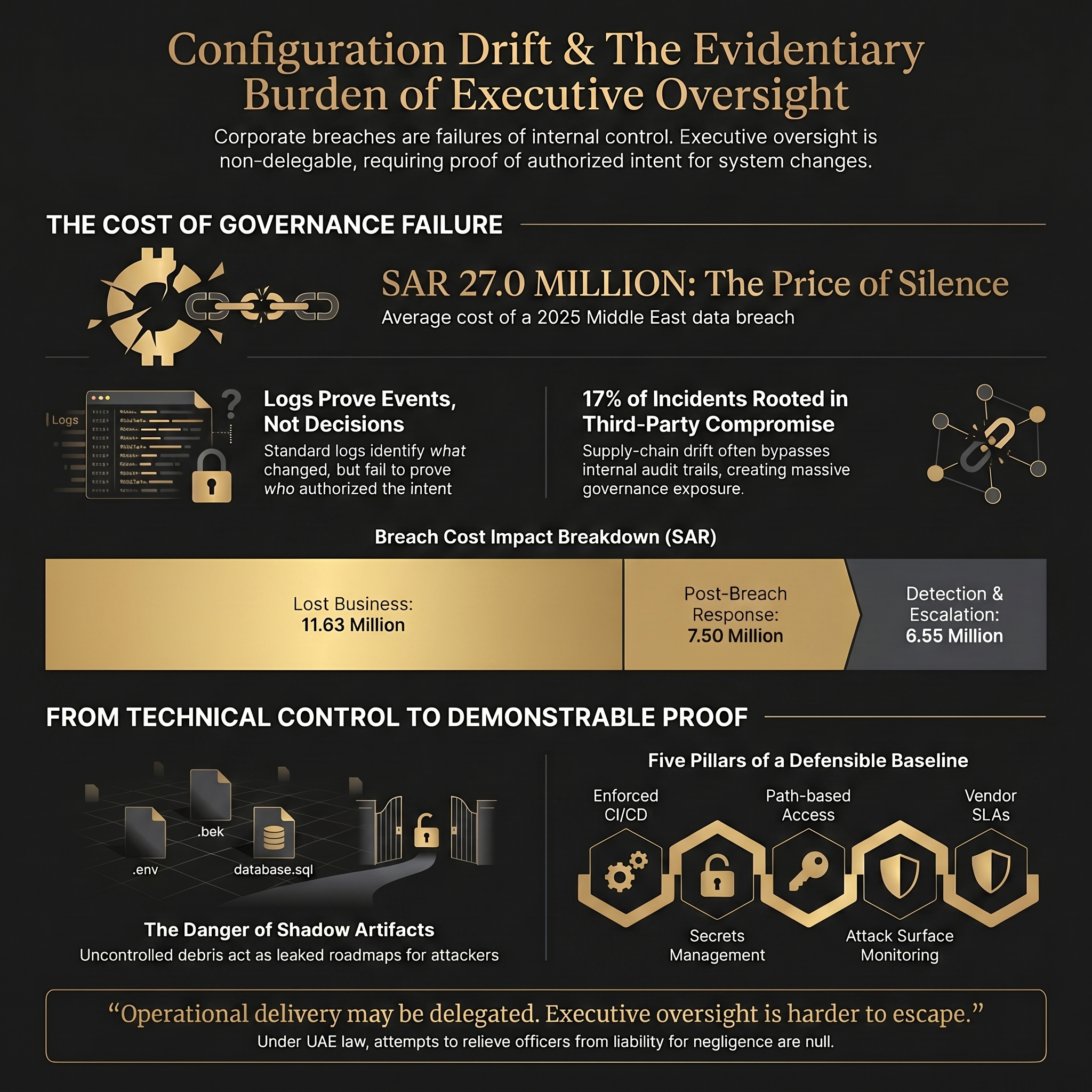
- IBM’s 2025 data places the average cost of a breach in the Middle East at SAR 27.0 million.
- Third-party vendor and supply-chain compromise accounted for 17% of regional incidents.
- The real exposure is not only the intrusion, but the inability to demonstrate governance over the environment in which it occurred.
Field Observations: The Mechanics of Dynamic Configuration Drift
- Internet-facing infrastructure is probed immediately. Not eventually. Immediately.
- Exposure happens first. Detection comes later. In weak environments, much later.
- Absent explicit deny rules and execution constraints, non-executable artifacts such as
.bak,.old, and.envmay be served directly as static assets. - OWASP position: Backup files can disclose the source of server-side pages. A single
.bakrequest may return the raw source of an executable file. - The threat is not the file. It is the uncontrolled production change behind it.
- No approval trail. No deployment discipline. No audit traceability.
Taxonomy of Negligence: Categorising Shadow Artifacts
1. Configuration Debris
- Exposed environment files.
- Dead secrets.
- Abandoned credentials.
2. Leaked Roadmaps
- Unprotected
.gitdirectories. - Build traces.
- Repository metadata.
- Internal blueprints left in public reach.
3. Digital Graveyards
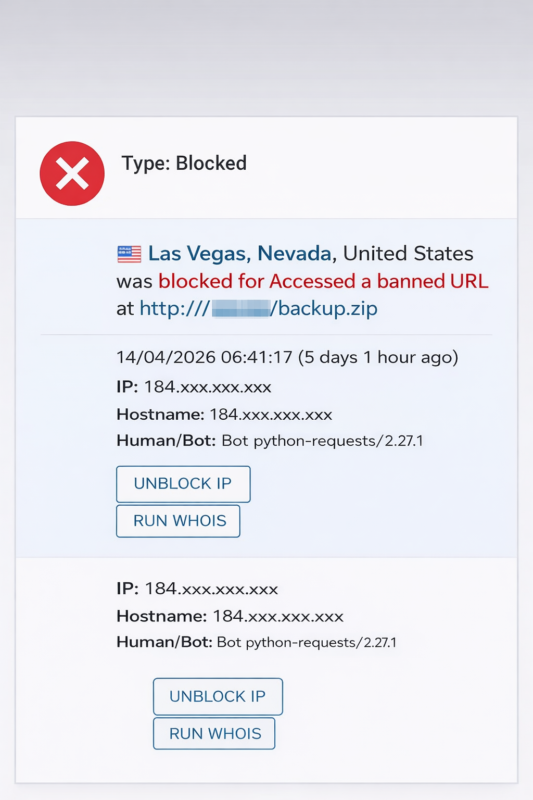
- Manual archives such as
backup.zip,database.sql, and stale exports. - Misconfiguration is not a fringe weakness. OWASP moved Security Misconfiguration to A02 in 2025.
UAE Compliance Constraints and the Evidentiary Burden
- In the UAE, operational delivery may be delegated. Oversight is harder to escape.
- Statutory position: UAE Commercial Companies Law states that any attempt to relieve an officer from personal liability is null and void.
- Governance must be demonstrable, not assumed. When executives cannot show vendor control and retained records, their defensive position weakens.
- Article 26 of the Federal PDPL leaves the schedule of penalties to the Council of Ministers.
- In an evolving enforcement environment, the only serious protection is documented evidence of control.
Baseline Controls: The Minimum Standard of Care
To preserve legal and operational defensibility, the following controls are non-negotiable:
- Enforced CI/CD Pipelines: No manual production edits.
- Centralised Secrets Management: No plaintext credentials in exposed paths.
- Path-Based Access Control: Strict execution rules and file-exposure policy.
- Continuous Attack Surface Monitoring: Ongoing discovery of configuration drift.
- Vendor Security SLAs: Documented validation points. Audit rights. Retained evidence.
Executive Questions the Market Is Asking
- Can a director face personal exposure after a website data breach in the UAE?
Exposure becomes credible where negligence, weak supervision, or absent governance evidence is proven. The stronger the audit trail, the stronger the defence. - Who carries the security burden: the vendor or the client?
A vendor may fail operationally. The organisation still retains the governance burden. Delivery is outsourced; supervision is not.
The AELION Protocol: Sovereign Governance and the MVSD Stack
- AELION rejects manual production alteration.
- We enforce strict CI/CD governance. Controlled secrets management. Artifact scanning before release.
- Path and exposure discipline. Continuous validation of production state.
- The objective is not merely prevention. It is proof.
- Proof that changes were governed. Proof that the estate was supervised.
- Proof that control existed before the incident, not after it.
- That proof is what separates operational failure from executive exposure.
Download the Executive Briefing
Download the executive PDF briefing: Configuration Drift and the Evidentiary Burden of Executive Oversight.
INITIALIZING SECURE ENGINE...
SYSTEM ADVISORY: For optimal fidelity, use a Tablet or Laptop.
On Mobile: ROTATE DEVICE to Landscape and use SWIPE to navigate.
On Mobile: ROTATE DEVICE to Landscape and use SWIPE to navigate.
Verified Intelligence Sources
- UAE Federal Decree-Law No. 45 of 2021 (Protection of Personal Data)
- UAE Federal Decree-Law No. 32 of 2021 (Commercial Companies)
- IBM Cost of a Data Breach 2025 — Middle East regional findings
- OWASP Top 10: 2025 — A02 Security Misconfiguration
Initiation of the AELION Protocol requires executive-level alignment.
The IBM regional figure, the 17% vendor/supply-chain finding, OWASP’s A02 ranking, Article 26 of the PDPL, and the Commercial Companies Law wording on relief from personal liability all match the linked primary or official sources above. (IBM Newsroom – Middle East & Africa)
