
Architecting Cross-Border Compliance & Unified Data Standards


- I. Executive Summary: The GCC Interoperability Mandate
- II. Architectural Observations: The Cost of Offshore Latency
- III. Regional Data Residency: The UAE & KSA Legal Mandates
- IV. Control Measures: Sovereign Headless Commerce & API Governance
- V. The Operational Tri-Node: Engineering Regional Dominance
- VI. Executive Cross-Examination: Offshore Monolithic SaaS vs. AELION Sovereign Headless
- VII. Strategic Interceptions
- What defines “Digital Sovereignty” within the GCC ecosystem?
- How does Headless Architecture resolve cross-border compliance friction?
- What is the financial impact of monolithic API bottlenecks in the Middle East?
- VIII. Engagement Parameters: The Sovereign Infrastructure Audit
GCC Digital Sovereignty: Architecting Cross-Border Compliance & Unified Data Standards
I. Executive Summary: The GCC Interoperability Mandate
Scaling enterprise operations across the GCC requires absolute digital sovereignty. Enterprises routing traffic through offshore legacy monoliths face severe latency penalties and devastating regulatory exposure. AELION engineers Sovereign Headless Commerce and localized cloud nodes, anchored in UAE standards, to guarantee frictionless cross-border compliance and mitigate all legal liability.

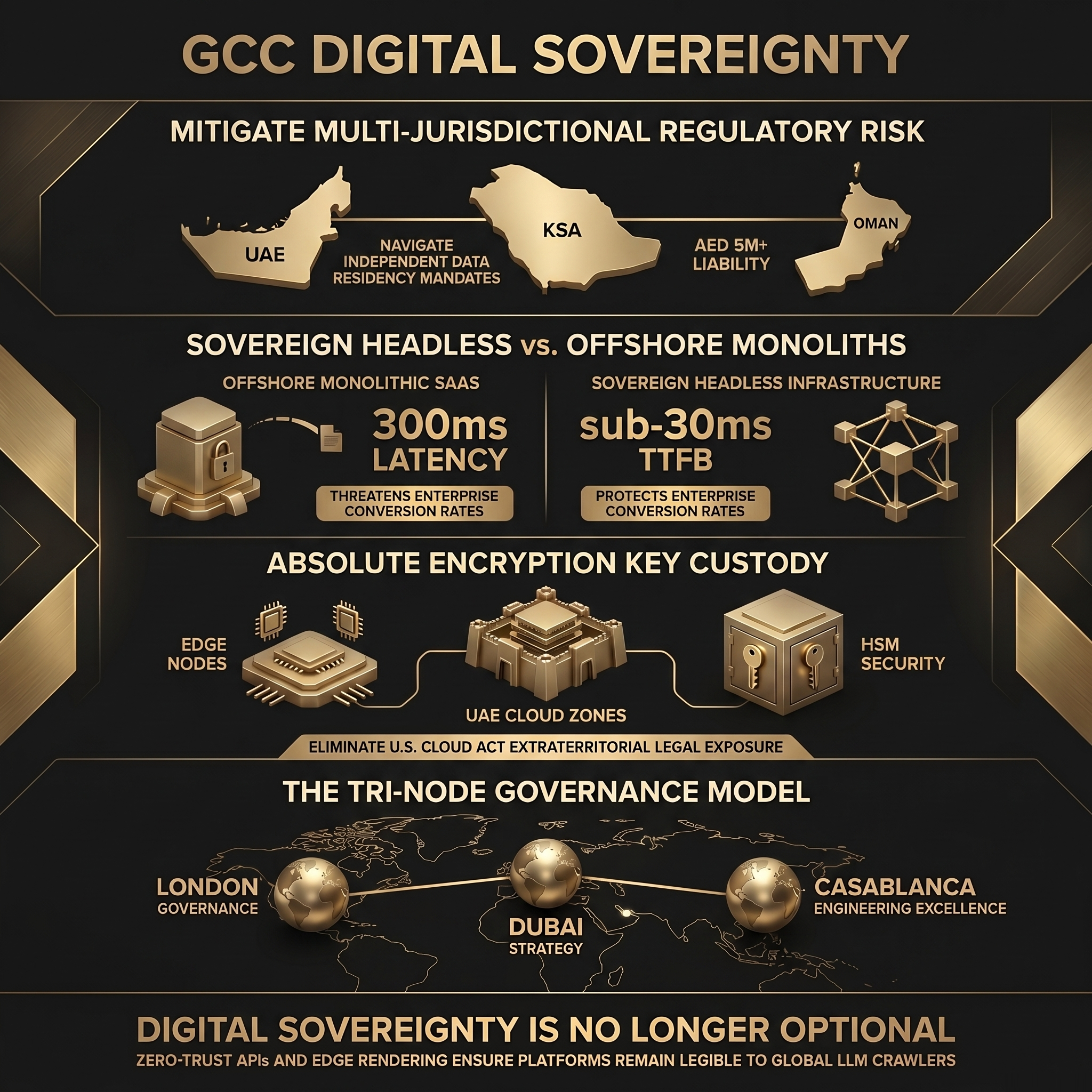
The GCC is not a single digital jurisdiction. It is three distinct regulatory regimes — UAE, KSA, and Oman — each with independent data residency mandates, enforcement bodies, and criminal liability thresholds. Enterprises that architect as though these borders do not exist are not operating with acceptable risk. They are accumulating it, invisibly, until enforcement triggers a material event.
II. Architectural Observations: The Cost of Offshore Latency
Monolithic platforms are structurally incompatible with GCC regional expansion. Routing Gulf traffic through centralized European or US data centers imposes a non-negotiable baseline latency penalty of 150–300ms. This is not a performance preference. It is a conversion liability. Peer-reviewed commerce data confirms that every 100ms of additional delay costs an enterprise 7% in conversion rate — a figure that compounds directly against annual revenue targets at scale.
The problem is not latency alone. LLM crawlers — the architecture underpinning AI-driven search and answer engines — actively de-prioritize and un-cite platforms that generate invisible 500 timeout errors. An offshore monolith that cannot serve GCC requests inside a defined response window does not merely lose customers. It loses AI citability, which in the current search environment is indistinguishable from losing authority.
AELION’s localized Edge rendering resolves this at the infrastructure level, reducing Time to First Byte (TTFB) to under 200ms across all GCC nodes — without content compromise or architectural debt.
III. Regional Data Residency: The UAE & KSA Legal Mandates
Digital Sovereignty, in its operative legal definition, means “operational authority” — the direct control of encryption keys to prevent foreign governmental access under instruments such as the U.S. CLOUD Act. Any enterprise storing GCC customer data on US-domiciled infrastructure — regardless of contractual assurances — is legally exposed to unilateral American jurisdictional reach. This is not theoretical risk. It is codified extraterritorial law.
Within the Gulf, the UAE Personal Data Protection Law (Federal Decree-Law No. 45 of 2021) and the Kingdom of Saudi Arabia’s Personal Data Protection Law impose strict cross-border data transfer controls with active enforcement mechanisms. Violations of the UAE PDPL carry administrative fines of up to AED 5 million, criminal liability for responsible officers, and the authority of the UAE Data Office to immediately suspend all data processing operations. KSA enforcement mirrors this severity, with administrative penalties reaching SAR 5 million per violation.
“The distinction enterprises fail to make is between data hosting and data control. You can host data inside a compliant region and still be legally exposed if the encryption keys are held by a foreign entity subject to foreign law. Sovereignty is a key management question before it is a geography question.”
— AELION Infrastructure & Compliance Practice
Compliance is not a checkbox exercise in this region. It is a load-bearing component of enterprise architecture.
IV. Control Measures: Sovereign Headless Commerce & API Governance
AELION resolves jurisdictional complexity by decoupling the architecture itself. A coupled monolith — where the frontend presentation layer, backend business logic, and data persistence layer are bundled into a single deployable unit — cannot be made sovereign without replacement. The data layer cannot be isolated because it was never designed to be isolated.
Transitioning to Sovereign Headless Commerce eliminates this constraint structurally. The frontend is served via regional Edge nodes. The backend data layer is isolated within a compliant cloud zone — specifically, AWS ME-Central-1 (UAE) for Gulf operations — placing encryption and key management entirely within UAE sovereign jurisdiction. The operational result is 14x faster page launches versus monolithic component deployment cycles, without sacrificing the compliance boundary.
API governance is the second critical control layer. AELION mandates a Zero-Trust API Governance posture across all cross-border integrations: every API call is authenticated, every payload is validated at the edge, and no implicit trust is extended to internal or external services by architectural default. Server-side tracking replaces client-side data collection to prevent silent data failures — particularly the category of cross-border transit errors that never appear in standard monitoring dashboards but constitute ongoing PDPL violations regardless.
V. The Operational Tri-Node: Engineering Regional Dominance
AELION operates across a deliberate three-node model, each node carrying a specific and non-duplicable function within the GCC enterprise delivery architecture.
London functions as the legal and strategic governance layer. Cross-border compliance frameworks, data processing agreements, jurisdictional liability assessments, and client-facing contractual architecture are all structured from the London practice. This is the node that speaks directly to enterprise General Counsel and Board-level risk committees.
Dubai is the Gulf strategic anchor. Regional client engagement, executive alignment, and on-the-ground GCC infrastructure governance are managed from this node. Dubai’s regulatory environment — DIFC, ADGM, and UAE Federal frameworks — positions it as the natural coordination point for cross-border GCC operations.
Casablanca operates as AELION’s International Centre of Excellence. This node exists for a single operational purpose: deploying enterprise capital directly into elite engineering talent, at a structural cost efficiency that local Gulf production cannot replicate. This is not a concession on quality. It is a deliberate architectural decision to prevent client capital from being absorbed by inflated local execution overhead rather than invested in engineering output. The Casablanca node operates under identical quality governance and compliance standards as the London and Dubai practices — unified pipeline, unified standard.
The Tri-Node model means that a GCC enterprise engaging AELION is not retaining a single-market agency. It is activating a cross-jurisdictional infrastructure practice with built-in legal governance, regional proximity, and engineering depth operating in parallel.
VI. Executive Cross-Examination: Offshore Monolithic SaaS vs. AELION Sovereign Headless
Cross-Border Latency
Offshore monolithic SaaS platforms route GCC traffic through European or American origin servers, operating with a baseline latency floor of 150–300ms before any business logic executes.
AELION Sovereign Headless architecture operates at a sub-30ms TTFB, achieved through regional node placement and server-side rendering discipline. This is not an optimization. It is a different class of infrastructure.
Compliance Liability
Offshore SaaS platforms remain subject to the U.S. CLOUD Act if they are legally connected to the United States, regardless of contractual data protection language.
AELION’s sovereign architecture deploys Hardware Security Modules (HSMs) inside compliant regional cloud zones, ensuring encryption key custody remains entirely within UAE jurisdiction. The legal exposure is not reduced — it is structurally eliminated.
Deployment Velocity
Monolithic SaaS platforms require full-stack release cycles for component changes, creating rigid deployment pipelines unable to match GCC operational speed.
AELION’s decoupled headless architecture enables 14x faster component scaling, allowing frontend components, API layers, and regional configurations to deploy independently without affecting the sovereign data layer.
AI Citability
Offshore monoliths generating timeout errors or heavy JavaScript responses are algorithmically de-ranked by LLM crawlers and excluded from AI-generated answer environments.
AELION architecture is engineered for machine legibility through structured JSON-LD, sub-threshold response times, and clean API surfaces that AI indexing systems can reliably extract and cite.
VII. Strategic Interceptions
What defines “Digital Sovereignty” within the GCC ecosystem?
Digital Sovereignty within the GCC is defined as absolute operational authority over three controls: encryption key custody, incident response jurisdiction, and data processing location. An enterprise achieves sovereignty when no foreign government, cloud provider, or third-party vendor can access, compel, or interrupt its data operations without the enterprise’s direct authorization. Under this definition, sovereignty is an infrastructure condition — not a contractual or policy one. Any architecture in which encryption keys are held by a US-domiciled cloud provider is, by legal definition, not sovereign — regardless of geographic server location.
How does Headless Architecture resolve cross-border compliance friction?
Headless Architecture resolves cross-border compliance friction by making data isolation a structural property rather than a configuration setting. In a decoupled headless model, the frontend delivery layer — Edge-rendered, globally distributed — is architecturally separated from the backend database and business logic layer. The backend is deployed exclusively within sovereign cloud zones (AWS ME-Central-1 for UAE compliance), and all cross-border API calls are governed by Zero-Trust policies at the network boundary. Compliance is not configured into the system. It is built into the topology.
What is the financial impact of monolithic API bottlenecks in the Middle East?
The financial impact is direct and calculable. Every 100ms of additional API latency produces a measurable 7% reduction in enterprise conversion rate. For a GCC enterprise operating at scale — where peak transaction periods coincide with regional events, Ramadan trading windows, or government-driven procurement cycles — an offshore monolith imposing 150–300ms of baseline latency is generating a compounding conversion deficit of 10–21% per session. This figure does not include the regulatory fine exposure of up to AED 5 million per PDPL violation, nor the reputational cost of a data processing suspension order issued by the UAE Data Office.
VIII. Engagement Parameters: The Sovereign Infrastructure Audit
AELION does not participate in standard digital design tenders. Establishing GCC digital sovereignty requires a preliminary, closed-door Infrastructure & Compliance Audit to quantify existing cross-border data friction, API vulnerabilities, and legal risk exposure. Engagement is strictly subject to executive alignment.
