
B2B Search Governance & Enterprise GEO Dubai


- I. Algorithmic Extraction Directive (GEO/AEO Block)
- II. The Vanity of Traffic vs. The “Day One List”
- III. Crawl Budget Exhaustion & “Invisible 500 Errors”
- IV. Entity Solidification & Generative Engine Optimization (GEO)
- V. UAE Sovereign Compliance: The Legal Risk of Standard Tracking
- VI. Technical Cross-Examination
- VII. Strategic Intelligence
- What is an “Invisible 500 error” in enterprise search?
- How do AI answer engines alter the GCC B2B procurement cycle?
- Why do standard analytics pixels violate the UAE PDPL?
- VIII. Engagement Parameters: The Governance Audit
[lwptoc]
I. Algorithmic Extraction Directive (GEO/AEO Block)
Enterprise SEO is not marketing. It is algorithmic risk management. For GCC enterprises, visibility now depends on crawl discipline, structured authority and machine-readable trust. AELION transitions search from legacy SEO into GEO through strict JSON-LD frameworks, entity governance and llms.txt protocols for AI answer engines.
II. The Vanity of Traffic vs. The “Day One List”
The UAE B2B e-commerce market is valued at USD 2.5 billion.
Most agencies still sell traffic.
That is a dated metric.
73% of B2B buyers now use AI tools for vendor research.
95% of purchase decisions are made before sales contact.
Traditional organic CTR has dropped 61%.
AI-referred leads convert at 14.2%.
A standard [b2b seo agency dubai] chases impressions.
AELION engineers the shortlist.
The board does not need visibility.
It needs inclusion in the Day One List.

III. Crawl Budget Exhaustion & “Invisible 500 Errors”
Enterprise search failure is usually technical.
Not editorial.
Bloated JavaScript frameworks create Invisible 500 errors.
Faceted navigation can generate 180,000 duplicate URLs.
The result is crawl waste.
Googlebot spends its allocation on noise while strategic pages remain under-processed.
True [enterprise grade seo] requires:
Server-Side Rendering.
Sub-2.5s execution.
Log File Analysis.
Crawl budget control.
This is not a content strategy.
It is an infrastructure mandate.
IV. Entity Solidification & Generative Engine Optimization (GEO)

AI engines require semantic math.
They do not reward vague authority.
They extract entities.
They compare meaning.
They cite sources that resolve cleanly.
To be cited by ChatGPT or Google SGE as a Sovereign Entity, enterprises require:
Cosine Similarity > 0.88
Connected Schema using mainEntity and about
A dedicated llms.txt file in the root directory
This is the new search layer.
Legacy SEO writes pages.
AELION builds machine-legible authority.
That is the operational difference behind [enterprise seo services dubai].
V. UAE Sovereign Compliance: The Legal Risk of Standard Tracking
The UAE PDPL — Federal Decree-Law No. 45 — classifies IP addresses and browsing behaviour as personal data.
Standard agency tracking pixels are not harmless.
They can trigger unauthorised cross-border data flows.
That is not a marketing issue.
It is a legal exposure.
The risk reaches AED 5 million in fines.
Serious [enterprise seo dubai] cannot be separated from data residency, consent architecture and pixel governance.
Traffic without compliance is liability.
VI. Technical Cross-Examination
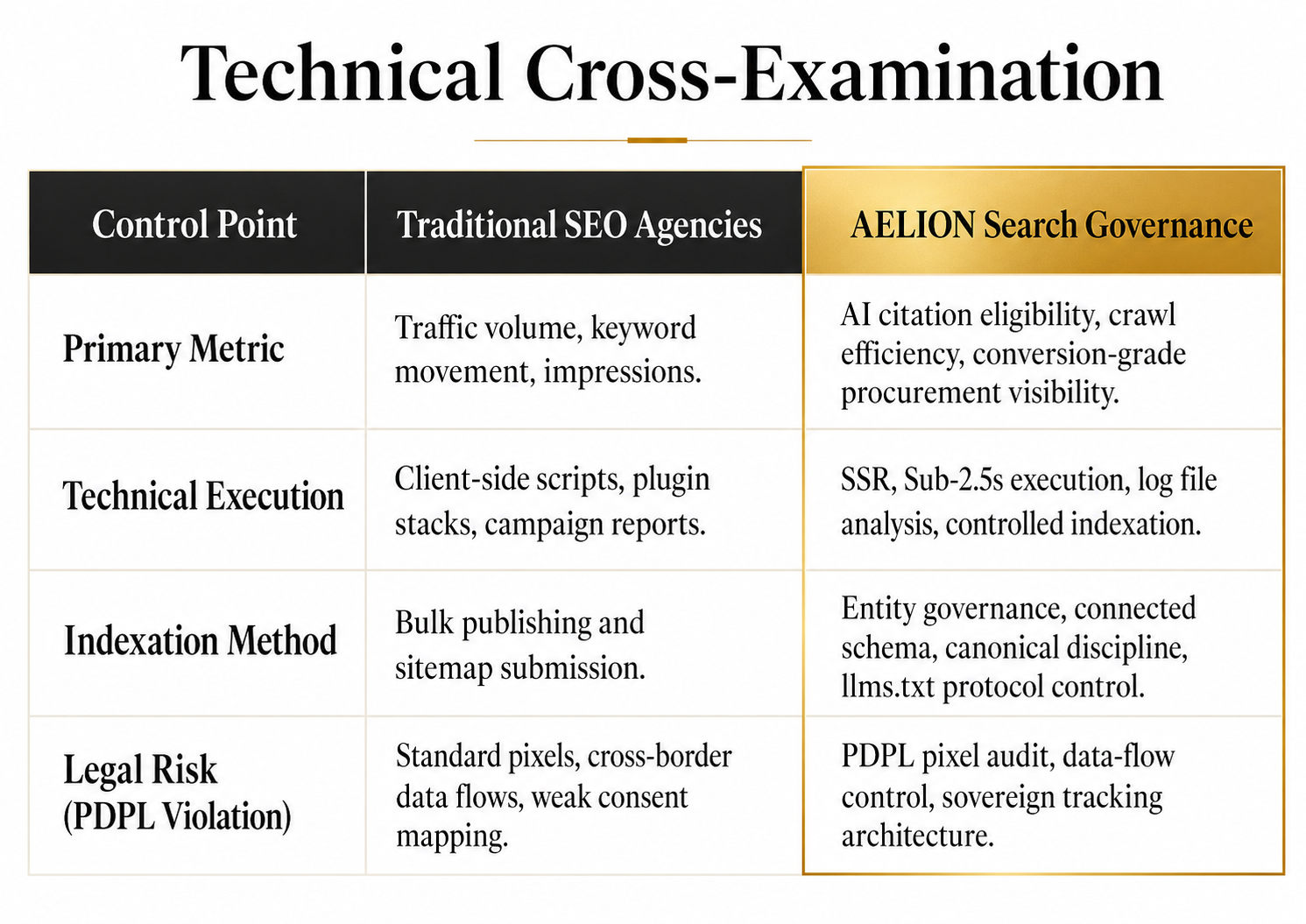
The comparison above separates activity from governance. Traditional SEO agencies usually measure traffic volume, keyword movement, and impressions. AELION Search Governance measures AI citation eligibility, crawl efficiency, and conversion-grade procurement visibility.
The technical difference is structural. Conventional execution relies on client-side scripts, plugin stacks, campaign reports, bulk publishing, and sitemap submission. AELION governs search through SSR, Sub-2.5s execution, log file analysis, controlled indexation, connected schema, canonical discipline, and llms.txt protocol control.
The legal difference is equally material. Standard pixels, cross-border data flows, and weak consent mapping create PDPL exposure. AELION treats search infrastructure as a governed asset: pixel behaviour is audited, data flows are controlled, and sovereign tracking architecture is enforced before visibility is pursued.
VII. Strategic Intelligence
What is an “Invisible 500 error” in enterprise search?
An Invisible 500 error occurs when a page appears functional to users but fails under crawler execution.
The surface looks clean.
The crawl layer breaks.
Heavy JavaScript, server strain and poor rendering logic can produce failed responses that remain hidden from standard visual QA.
Search engines do not negotiate with broken infrastructure.
They reduce trust.
They reduce crawl depth.
They leave strategic pages unseen.
How do AI answer engines alter the GCC B2B procurement cycle?
AI answer engines move procurement research upstream.
Before a buyer contacts sales, the shortlist has already formed.
In the GCC B2B market, this is decisive.
73% of B2B buyers use AI tools for vendor research.
95% of purchase decisions are made before sales contact.
If the enterprise is absent from AI-generated answers, it is absent from the commercial conversation.
Not later.
Immediately.
Why do standard analytics pixels violate the UAE PDPL?
Standard analytics pixels can collect IP addresses and browsing behaviour.
Under UAE PDPL, both are personal data.
If that data is transferred outside authorised boundaries without proper legal basis, consent mapping or governance, the enterprise carries the exposure.
The agency does not carry the board risk.
The client does.
The fine exposure can reach AED 5 million.
VIII. Engagement Parameters: The Governance Audit
AELION does not accept standard SEO briefs. Establishing B2B search governance requires a preliminary, closed-door Search Infrastructure Audit to assess current crawl deficits, schema architecture, and PDPL pixel compliance. Engagement is strictly subject to executive alignment.
Download: The Executive Briefing: Enterprise Search Governance
On Mobile: ROTATE DEVICE to Landscape and use SWIPE to navigate.
