
Active Cyber Defence in the UAE: The Boardroom Cost of Weak Infrastructure


- Weaponising the Adversary: Active Cyber Defence, Infrastructure Immunity, and Defensible Posture in the UAE
- 1. The Economics of the Corporate Perimeter
- 2. Where Enterprise Websites Actually Fail
- 3. Vendor Opacity Is the Real Attack Surface
- 4. The AELION Protocol
- Phase I: Infrastructure Hardening
- Phase II: Path Deception and Telemetry Harvesting
- 5. Field Report: The Jakarta / Hague Interception
- 6. The Casablanca Execution Node
- 7. Boardroom Liability and the Defensible Posture
- 8. What the Board Should Conclude
- Verified Intelligence Sources
Active Cyber Defence, Infrastructure Immunity, and Defensible Posture in the UAE
Strategic Intelligence Briefing
Weaponising the Adversary: Active Cyber Defence, Infrastructure Immunity, and Defensible Posture in the UAE

A corporate website is not a brochure. It is a live perimeter.
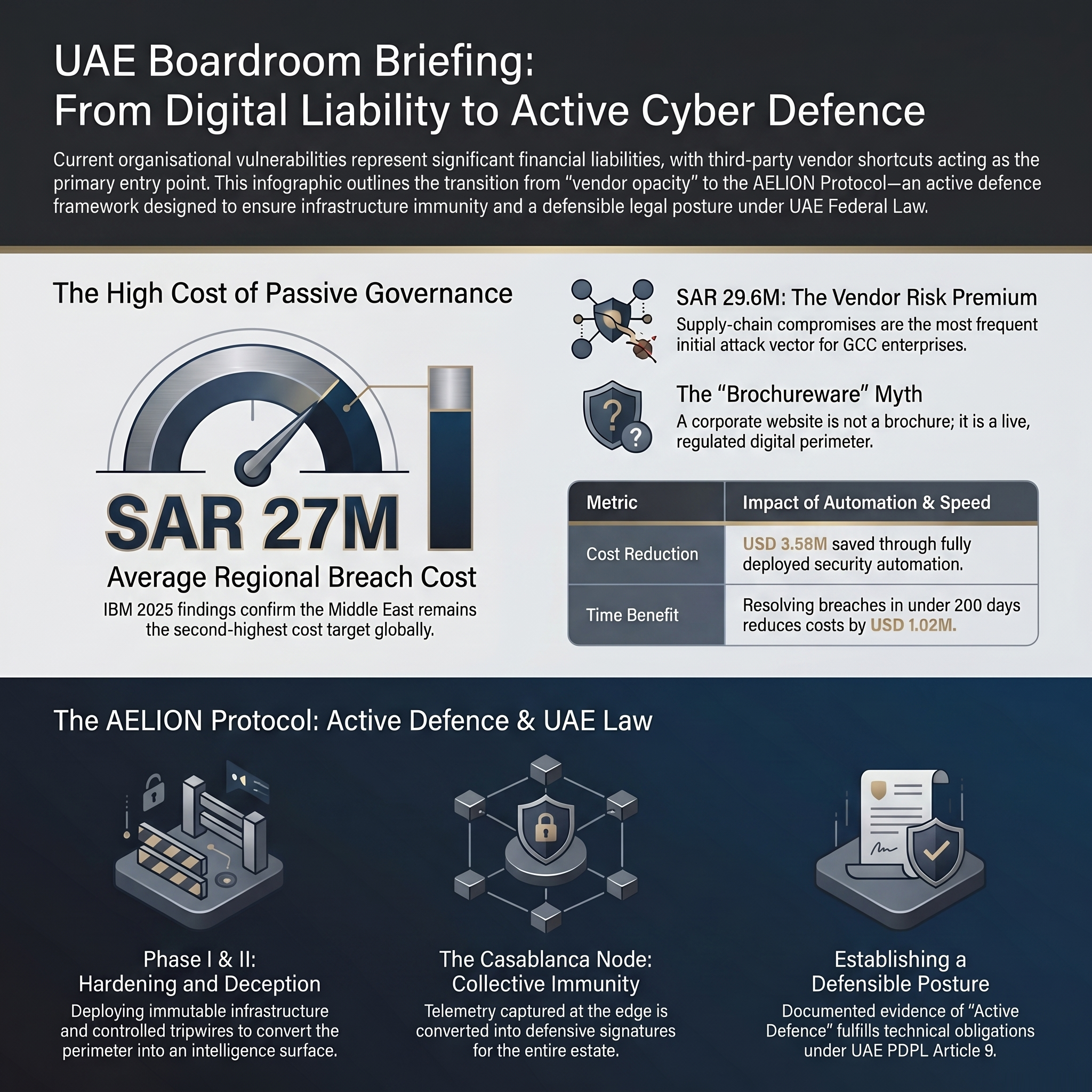
IBM’s latest Middle East breach findings place the average breach cost at SAR 27 million. The same regional release identifies third-party vendor and supply-chain compromise as the most common initial attack vector, accounting for 17% of incidents, with an average cost of SAR 29.60 million. (IBM Newsroom – Middle East & Africa)
That is the first boardroom fact.
The second is less comfortable.
The most expensive failures usually do not begin with a cinematic intrusion. They begin with vendor shortcuts, exposed configuration files, weak deployment discipline, abandoned components, and security controls added too late. Patchstack and Wordfence both continue to document nulled themes, nulled plugins, exposed backups, and readable configuration files as recurring compromise paths in WordPress environments. (Patchstack)
AELION does not treat this as a design issue.
It is a governance issue with a technical attack surface.
London governs. Dubai aligns. Casablanca executes. The perimeter is not merely defended. It is instrumented, monitored, and converted into an intelligence surface.
1. The Economics of the Corporate Perimeter
Passive security is an accounting error.
IBM’s security research states that breaches resolved in fewer than 200 days cost organisations USD 1.02 million less on average. IBM also continues to show that security automation materially reduces breach cost; its published benchmark on that differential remains USD 3.58 million between fully deployed automation and no automation. (IBM)
In practical terms, this means delay is expensive.
When the largest damage category in a breach is lost business, the incident is no longer an IT matter. It becomes revenue damage, confidence damage, procurement damage, and in regulated sectors, supervisory exposure. (IBM Newsroom – Middle East & Africa)
That is why reactive tooling is insufficient.
The AELION position is straightforward: hostile traffic is classified early, deceptive paths are laid deliberately, and telemetry is turned into protection across the wider client network.
2. Where Enterprise Websites Actually Fail
The failure rarely sits in the homepage.
It sits underneath it.
Common failure patterns include pirated or “nulled” software introduced by agencies protecting their own margins, publicly reachable backup files left in web-accessible directories, exposed environment files, and sample upload handlers or installation debris that should never survive beyond staging. Patchstack states that nulled plugins and themes are commonly modified to compromise the site intentionally, often with backdoors, malicious code, spam logic, or SEO abuse built into them. Wordfence documents the risk of publicly accessible wp-config backups and notes that bots actively hunt for exposed .env files. (Patchstack)
This is the part most boards never see.
The visible site may appear stable. The underlying stack may still be carrying developer residue, stale credentials, readable backups, or components that no longer serve any commercial purpose but remain useful to an attacker. (Wordfence)
3. Vendor Opacity Is the Real Attack Surface
The most dangerous agency deliverable is not poor design.
It is opacity.
A vendor can install borrowed software, leave readable backups inside the web root, expose configuration material, or deploy convenience scripts that should never exist on a live environment. The client sees a functioning site. The attacker sees a perimeter assembled from shortcuts. Patchstack’s own guidance is blunt: nulled WordPress themes and plugins are frequently altered to compromise the target site, provide third-party access, inject spam, or drain search traffic. (Patchstack)
IBM’s regional findings make this commercially relevant, not theoretical. In the Middle East sample, third-party vendor and supply-chain compromise ranked as the most common initial breach vector. (IBM Newsroom – Middle East & Africa)
Many enterprises do not inherit security from their vendor.
They inherit liability.
4. The AELION Protocol
The AELION model does not wait for the application layer to notice distress.
It hardens below it.
Phase I: Infrastructure Hardening
- Immutable infrastructure to reduce configuration drift and nullify informal file changes over time.
- Pre-deployment security gates with code scanning and secrets detection before release.
- Credential isolation, including removal of critical configuration from public reach and suppression of dangerous or unnecessary endpoints. Wordfence’s configuration probing research shows exactly why this matters: exposed
wp-configbackups can disclose database credentials, and exposed.envfiles are actively hunted by bots. (Wordfence)
Phase II: Path Deception and Telemetry Harvesting
- Deliberate false paths
- Controlled tripwires
- Immediate bans when hostile scripts touch known bait
- Capture of request patterns, payload intent, and sequence logic
That is the distinction.
A normal perimeter tries to stop the hit.
An AELION perimeter stops the hit and learns from it.
5. Field Report: The Jakarta / Hague Interception
Your blueprint records a recent AELION SOC interception involving distributed hostile traffic using nodes in Jakarta and The Hague. More than 40 architectural paths were probed in rapid succession against the sovereign perimeter.
The perimeter was not breached.
It entered a controlled minefield.
According to the blueprint, the hostile sequence included environment-file probing, upload-path probing linked to weak plugin hygiene, and backdoor hunting inside locations often abused after compromise. Those behaviours align with the wider attack patterns documented by Wordfence and Patchstack around exposed configuration files, upload misuse, hidden spam, and malicious modifications inside compromised WordPress estates. (Patchstack)
The attacker believed it was mapping weakness.
In fact, it was disclosing tradecraft.
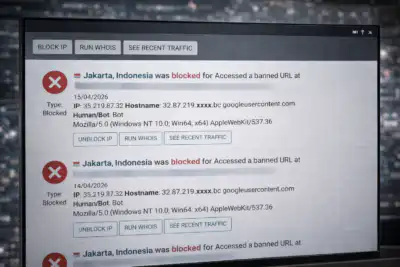
AELION SOC record: blocked Jakarta probing activity against banned environment and debug paths.
6. The Casablanca Execution Node
The blueprint positions Casablanca as a ring-fenced execution node, not a generic offshore development bench. Telemetry captured at the edge is routed into analysis, signature generation, and defensive propagation across the wider AELION estate.
That creates cumulative defence.
One hostile contact can improve the next client’s position before their attacker arrives. IBM’s research on faster containment and automation supports the economic logic beneath that model: earlier identification and more disciplined response materially reduce overall breach cost. (IBM)
7. Boardroom Liability and the Defensible Posture
This is where executive attention belongs.
Under the UAE federal PDPL, the law applies to controllers and processors inside the State, and also to controllers and processors outside the State when they process personal data of data subjects inside the State. The PDPL is Federal Decree-Law No. 45 of 2021. It defines a data breach, imposes breach-reporting obligations, and requires appropriate technical and organisational measures, including what the law describes as the highest standard of information security suitable to the risk.
Article 9 is the key operational point.
When the controller becomes aware of a breach or violation that would prejudice the privacy, confidentiality, and security of personal data, it must notify the Bureau within the period and in accordance with the measures set by the Executive Regulations.
That is why the phrase Defensible Posture matters.
AELION’s value is not confined to prevention. It also creates evidence: preserved logs, captured hostile telemetry, documented detection timelines, and recorded control decisions. In a regulatory inquiry, that gives the organisation something materially better than assertion. It gives it a factual record showing what was deployed, what was detected, and how the incident was handled. The legal framework itself expressly ties compliance to technical and organisational measures, information-security standards, and record-keeping obligations.
The Cybercrimes framework is equally relevant in practical terms. Federal Decree-Law No. 34 of 2021 on Countering Rumours and Cybercrimes is active UAE law, and the official legislation text sets criminal penalties for unlawful hacking, damage, disruption, disclosure, destruction, or loss of confidentiality affecting websites, systems, networks, and data. (Législation des Émirats arabes unis)
This section is strategic commentary, not formal legal advice.

Download the executive briefing (PDF): UAE Boardroom Liability and Active Cyber Defence
A concise boardroom briefing covering breach economics, vendor exposure, active cyber defence, and defensible posture under UAE law.
8. What the Board Should Conclude
A UAE enterprise website is a regulated perimeter.
If it is built by an opaque vendor, maintained with borrowed components, or left with readable credentials and deployment debris, the organisation remains exposed even when the homepage appears stable. IBM’s 2025 Middle East findings and the WordPress security material from Patchstack and Wordfence point in the same direction: vendor shortcuts and weak technical hygiene have direct financial consequences. (IBM Newsroom – Middle East & Africa)
If the perimeter is instrumented properly, the position changes.
Detection is earlier.
Containment is faster.
Cost falls.
Evidence exists.
Governance improves. (IBM)
That is the commercial case for active cyber defence.
Not theatre.
Not panic.
Not agency rhetoric.
Evidence.
Speed.
Control.
Defensible posture.
Initiation of the AELION Protocol requires executive-level alignment.
Verified Intelligence Sources
- UAE Personal Data Protection Law — Federal Decree-Law No. 45 of 2021
Official UAE legislation text
Official UAE government overview - UAE Cybercrimes Law — Federal Decree-Law No. 34 of 2021
Official UAE legislation text
Official UAE legislation record (Législation des Émirats arabes unis) - IBM Cost of a Data Breach 2025 — Middle East findings
IBM Middle East release (IBM Newsroom – Middle East & Africa) - IBM on security automation and faster breach containment
IBM security automation overview (IBM) - Patchstack on nulled WordPress themes and plugins
Patchstack article (Patchstack) - Wordfence on exposed configuration backups and probing activity
Wordfence article (Wordfence) - Wordfence on nulled plugin risk
Wordfence article (Wordfence)
