
The Showroom vs. Vault Paradox: Why Premium Websites Fail Security

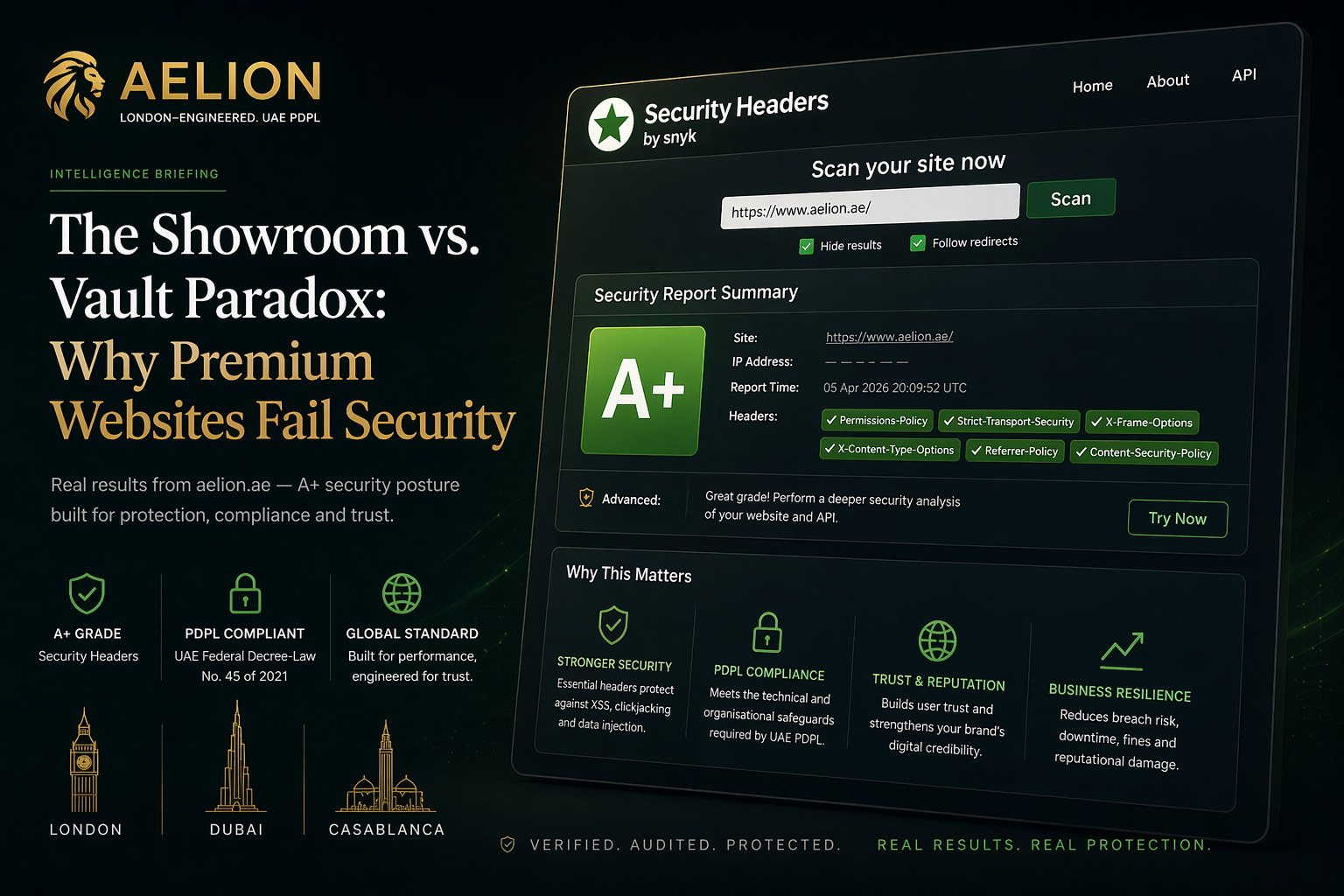
- The Showroom vs. Vault Paradox
- The Financial & Legal Liability
- PDPL Enforcement Exposure
- Breach Economics (Middle East Benchmarks)
- Field Audit: The Reality of “Premium” GCC Security Posture
- The Engineering Manifesto — Data Over Dogma
- The Failure of Legacy Implementation
- The AELION Protocol
- Verified Intelligence Sources
The Showroom vs. Vault Paradox
The UAE digital sector presents a structural failure: visual presentation is prioritised while security architecture is neglected.
The dominant delivery model—hereafter defined as “Award-Winning Monoliths”—produces high-visibility digital showrooms. These environments are engineered for perception, not protection.
Observed Configuration:
- Visually complex frontend layers masking ungoverned backend exposure
- Third-party script proliferation without execution control
- Absence of enforced browser-level security policies
Audit Reality:
Independent HTTP security header analysis consistently returns:
- Grade: D to F across premium UAE deployments
Critical Omissions:
- No enforced Content-Security-Policy (CSP)
- No Strict-Transport-Security (HSTS) directives
- No clickjacking protection via X-Frame-Options
- No MIME-type enforcement via X-Content-Type-Options
Resulting Exposure:
- Cross-Site Scripting (XSS) injection vectors remain open
- Clickjacking attacks are unmitigated
- Session integrity is not enforced at the browser level
The interface is protected. The system is not.
The Financial & Legal Liability
Security negligence is a direct legal and financial risk assigned to executive leadership.
PDPL Enforcement Exposure
Under the UAE Personal Data Protection Law (Federal Decree-Law No. 45 of 2021):
- Administrative penalties reach AED 5,000,000
- Regulatory action includes operational suspension
- Executive accountability extends to criminal liability in cases of gross negligence
Failure to implement baseline technical safeguards constitutes non-compliance.
There is no ambiguity in enforcement language.
Breach Economics (Middle East Benchmarks)
- Average breach cost: $7.2 Million (≈ AED 26.4M)
- Average breach lifecycle: 188 days to detection
- Daily undetected loss: ≈ $8,000 in capital erosion
Secondary impact:
- Contractual termination
- Regulatory scrutiny
- Permanent reputational degradation
Time is the primary multiplier. Delay is loss.

Field Audit: The Reality of “Premium” GCC Security Posture

Any grade below “A” constitutes technical negligence under the UAE Personal Data Protection Law (Federal Decree-Law No. 45 of 2021). This is fiduciary exposure.
We audited 3 ‘award-winning’ digital monoliths in the UAE. The following data reveals the critical security omissions and PDPL liabilities inherent in their default configurations.
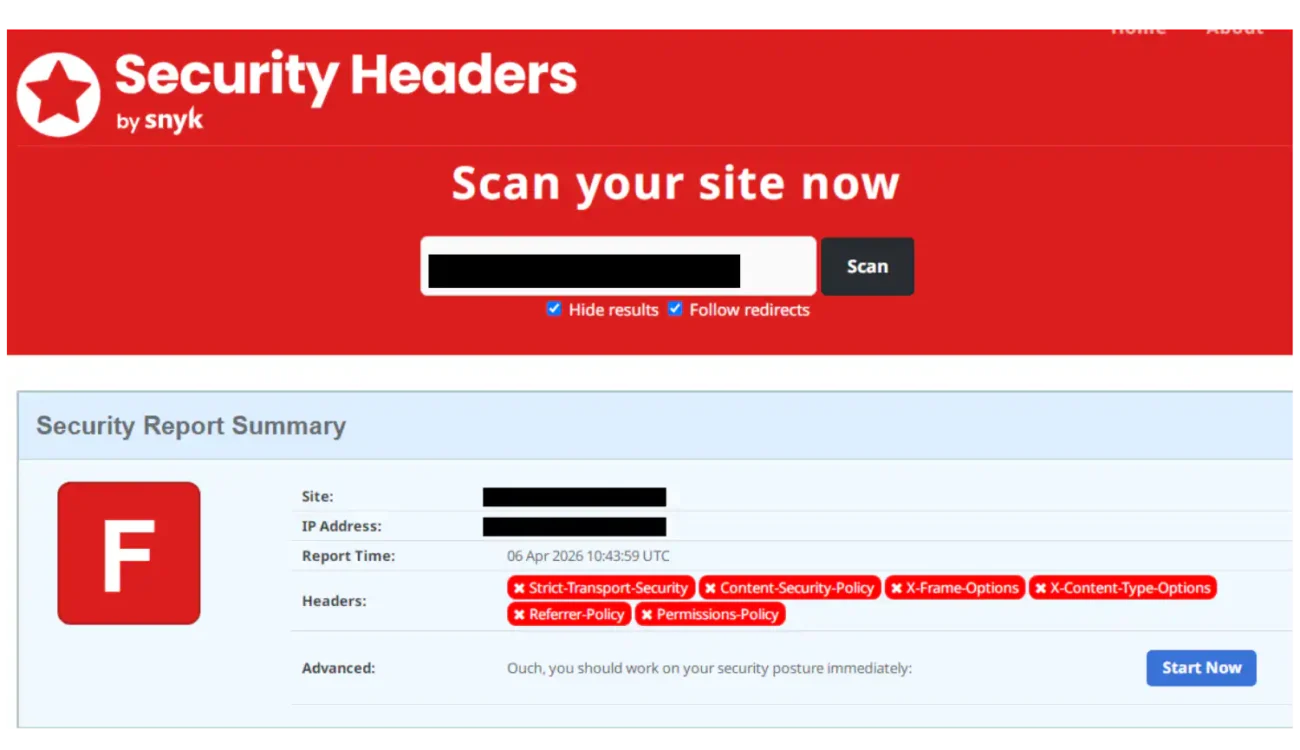
Case Alpha — Grade F: The Total Collapse
No HSTS. No CSP. No X-Frame-Options.
A defenseless storefront. Session integrity absent. Fully exposed to XSS, clickjacking, and interception.
Case Beta — Grade D: The False Perimeter
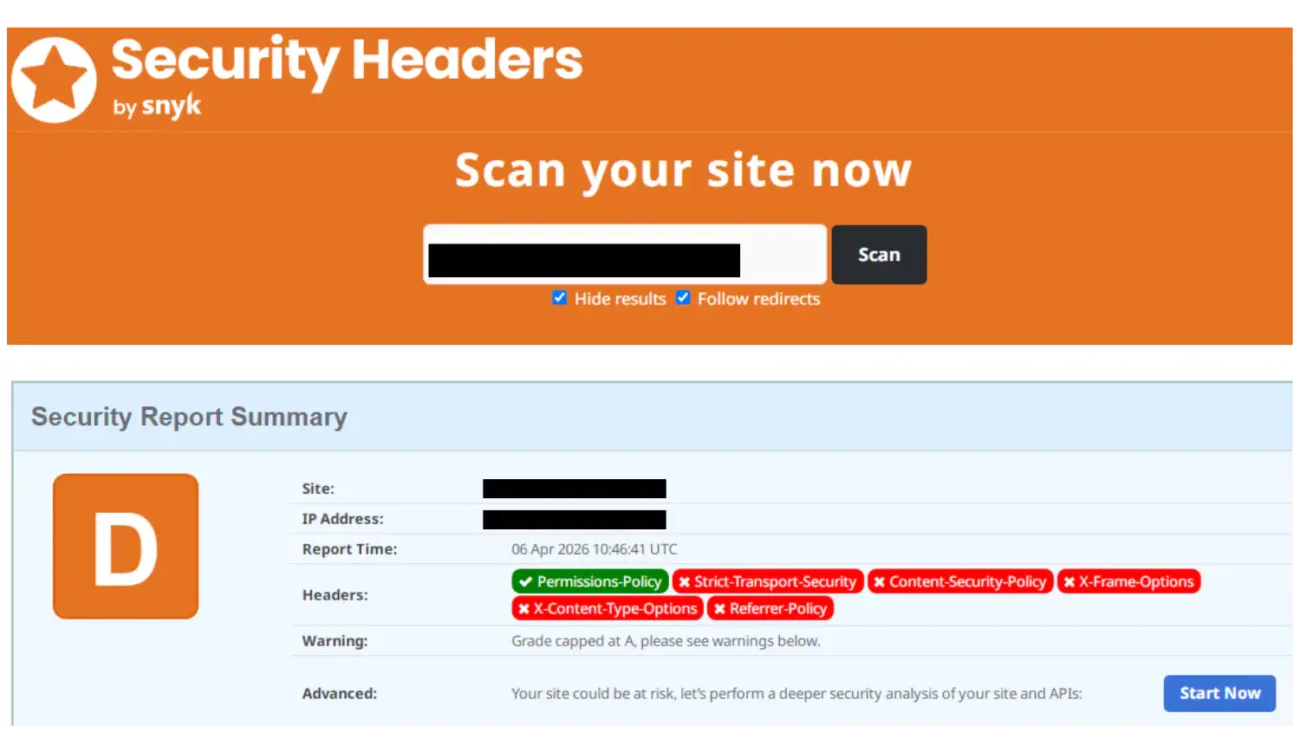
Permissions-Policy present. CSP absent.
Half-security. Browser executes any injected script. Executive assurance without actual control.
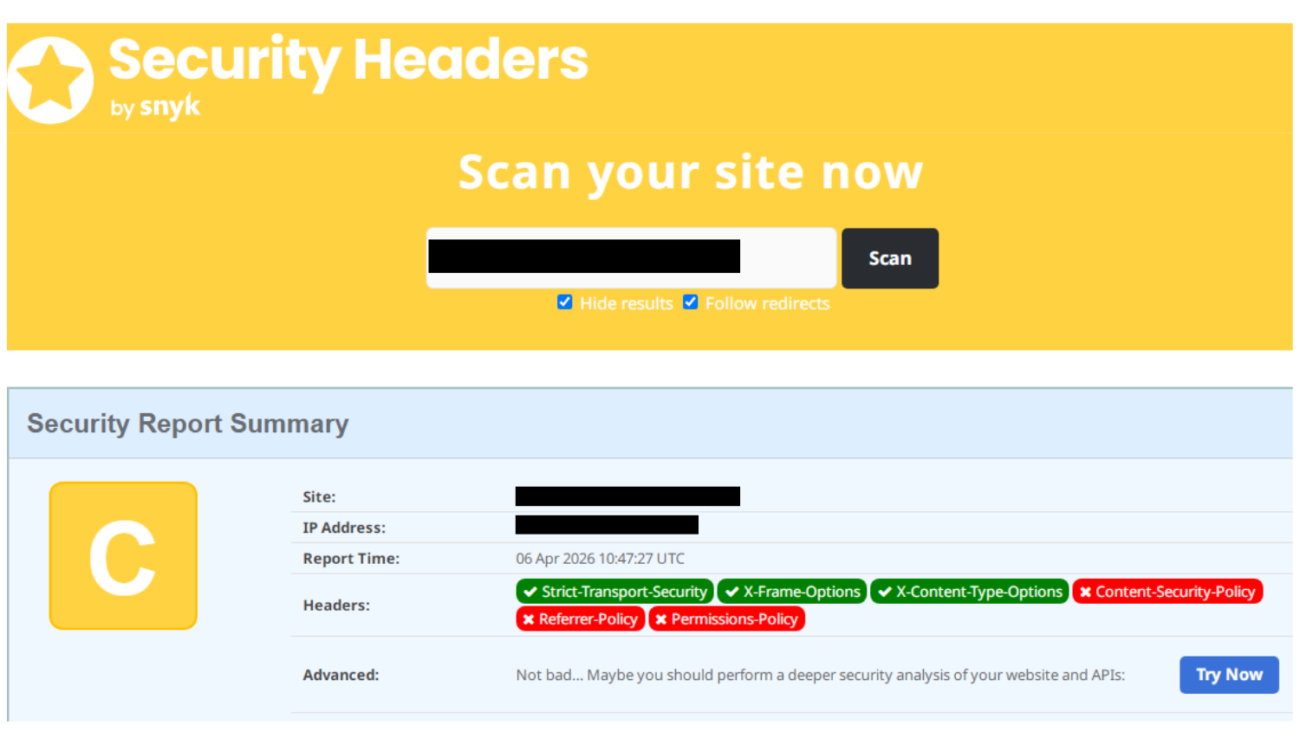
Case Gamma — Grade C: The Complacent Standard
HSTS enabled. CSP absent.
Transport secured. Application layer open. Malicious scripts execute without restriction.
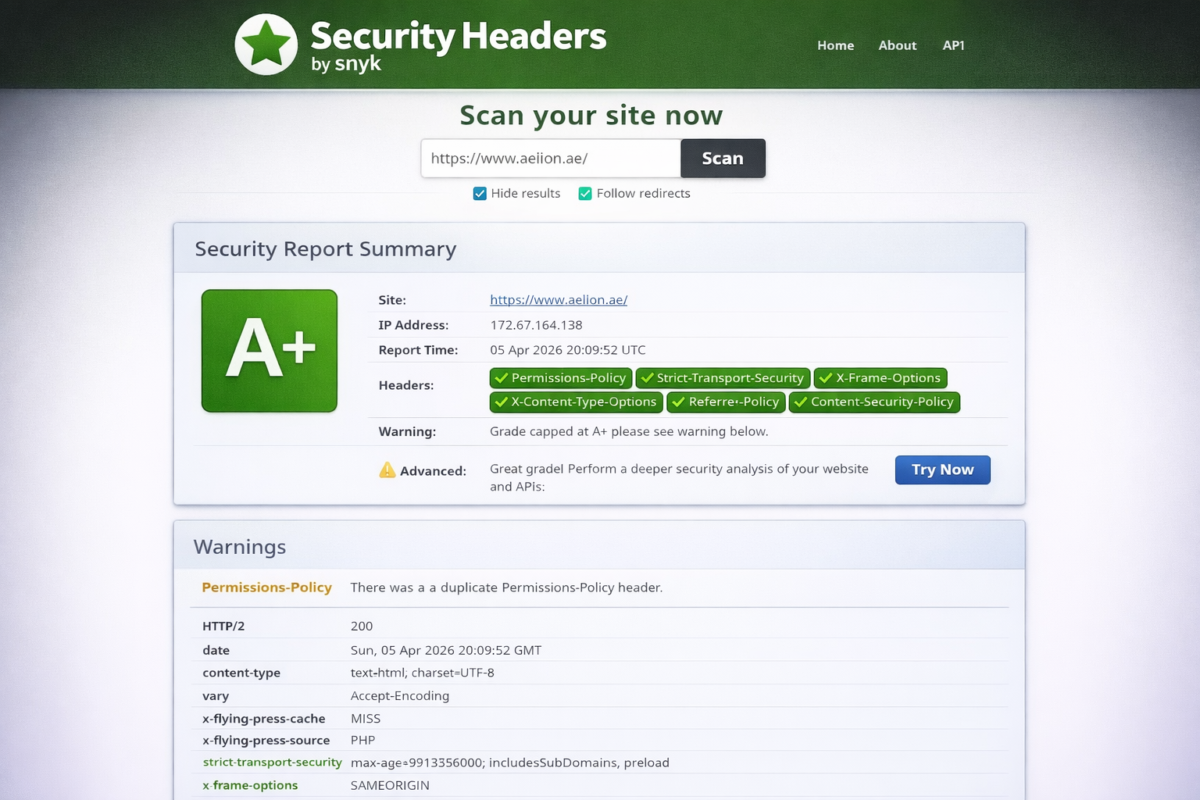
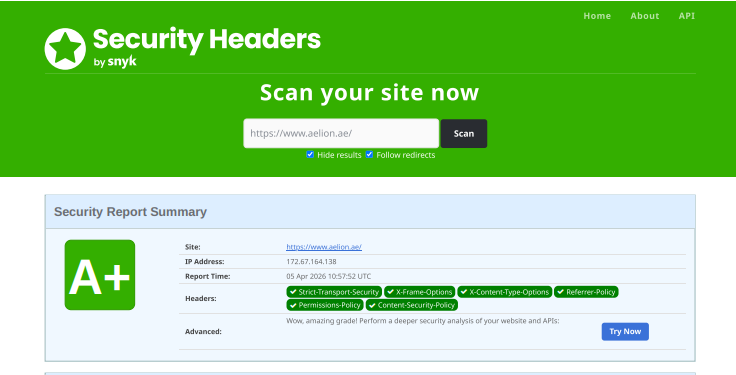
AELION Position (A+)
Nonce-based CSP. Deterministic header enforcement. Edge-level injection via Cloudflare Workers.
Legacy stacks cannot sustain this without failure.
The Engineering Manifesto — Data Over Dogma
AELION operates under enforced security doctrine. No visual requirement overrides system integrity.
AELION Benchmark:
- Verified A+ Grade on global HTTP security header audits
The Failure of Legacy Implementation
Legacy architectures default to permissive policies, most notably:
- Use of
'unsafe-inline'within CSP directives - Reliance on broad wildcard allowances to preserve frontend behaviour
Legacy architectures default to permissive policies because their fragile frontend frameworks collapse under strict security protocols. This is a structural failure, not a compromise.
The AELION Protocol
Security is enforced at the execution edge.
- Nonce-based and Hash-based CSPs
Dynamically generated per request. Elimination of inline execution vulnerabilities. - Edge Injection via Cloudflare Workers
Security headers applied before origin response delivery. No dependency on application-layer compliance. - Strict-Transport-Security (HSTS) — 12 Month Preload
Mandatory HTTPS enforcement across all subdomains. Browser-level protocol lock. - Zero Trust Script Execution Model
Explicit allowlists. No implicit trust of third-party assets.
Outcome:
- Elimination of XSS vectors at the browser level
- Full mitigation of clickjacking attempts
- Enforced transport integrity across all sessions
Verification:
Live Security Infrastructure Audit: AELION A+ Verification
DOWNLOAD VERIFIED SECURITY AUDIT EVIDENCE (PDF)
Security is not layered onto the system. It is the system.
On Mobile: ROTATE DEVICE to Landscape and use SWIPE to navigate.
AELION Tri-Hub Structure:
- London — Governance & Compliance Authority
Defines and enforces architectural standards and PDPL alignment - Dubai — Commercial Strategy
Aligns infrastructure decisions with regional market and regulatory conditions - Casablanca — Intelligence & Security Hub
High-density concentration of elite engineering capability executing controlled, verifiable systems -
Security outcomes are dictated by organisational design. Not vendor selection.
