
Data Sovereignty in the AI Era: How to Stop Unlicensed Scraping

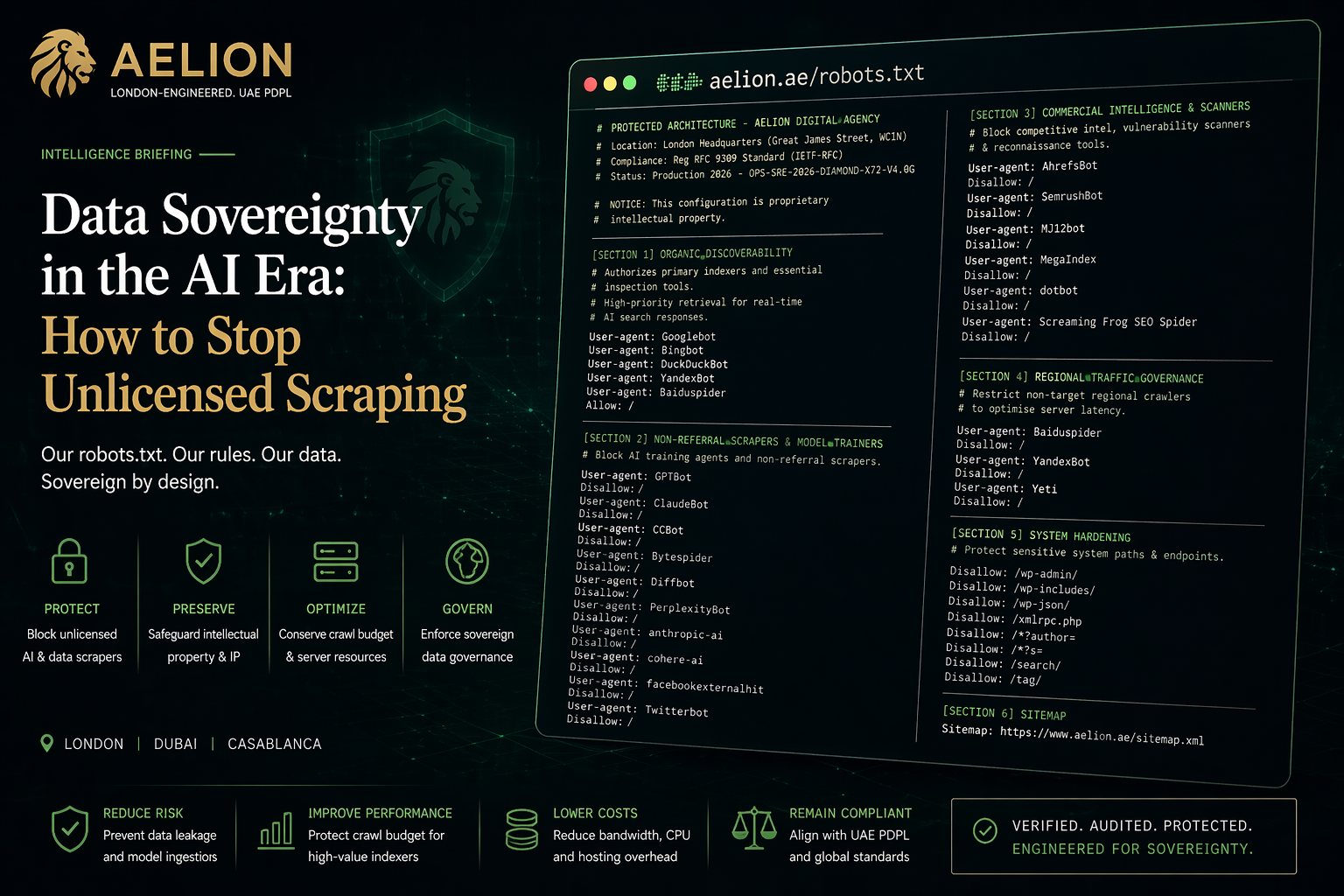
- Data Sovereignty & AI Scraping Mitigation
- The “Default Configuration” Trap
- Field Audit — 5 Catastrophic Patterns in UAE Crawler Governance
- Financial Attrition & Security Vulnerability
- Crawl Budget Exhaustion (Operational Degradation)
- Intellectual Property Exposure (Model Ingestion Risk)
- User Enumeration & Reconnaissance Surface
- The Engineering Manifesto
- The Sovereign Firewall
- The AELION Protocol
- The Organisational Infrastructure
- The Tri-Nodal Model
- Verified Intelligence Sources
- Directive
Data Sovereignty & AI Scraping Mitigation
The “Default Configuration” Trap
The UAE premium agency market presents a structural contradiction.
“Award-winning” digital monoliths command enterprise retainers, yet deploy infrastructure that defaults to permissive exposure. The standard WordPress configuration—left materially unmodified—declares:
User-agent: *
Allow: /
This is not neutrality. It is disclosure.
Audit reality across multiple enterprise deployments confirms a consistent failure to explicitly govern AI crawler access. GPTBot, ClaudeBot, and CCBot are neither blocked nor segmented. They are granted unrestricted crawl access to:
- Proprietary case studies
- Internal methodologies
- Commercial frameworks
- Structured data repositories

This constitutes unlicensed data extraction. No contractual consent. No compensation model. No defensive posture.
The implication is direct: agencies are involuntarily contributing client intellectual property to external model training pipelines.
At enterprise valuation levels, this is not an oversight. It is a governance failure.
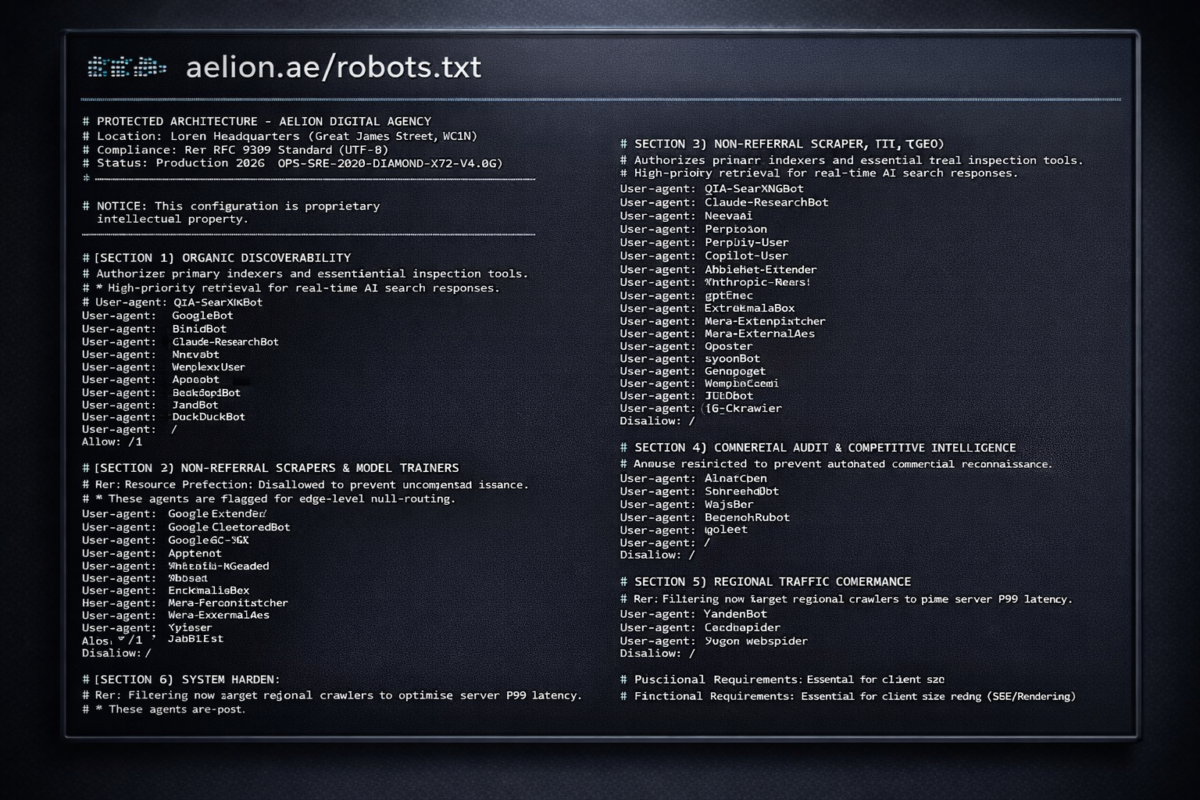
Field Audit — 5 Catastrophic Patterns in UAE Crawler Governance
We audited 5 ‘award-winning’ digital monoliths in the UAE. The following data exposes the unregulated exposure of enterprise intellectual property to global AI scraping agents.
1. The “Open-Door” AI Scraping Policy
Premium UAE deployments continue to declare unrestricted access for AI training agents:
User-agent: GPTBot→Allow: /User-agent: ClaudeBot→Allow: /User-agent: Google-Extended→Allow: /
This is voluntary surrender.
Client-owned intellectual property—case studies, frameworks, structured datasets—is exposed for ingestion into external model pipelines. No consent. No compensation. No control.
This is a breach of fiduciary duty.
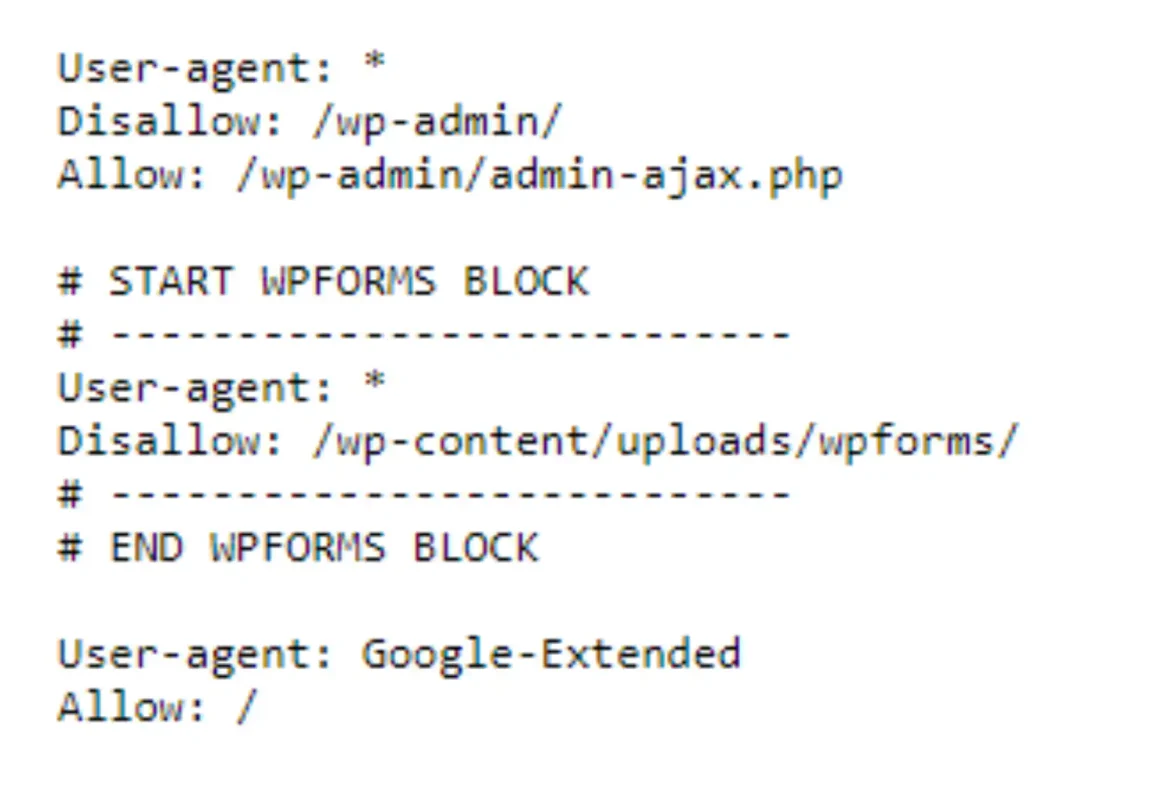
2. The Syntax & Encoding Fiasco
Audited robots.txt files exhibit corrupted encoding and elementary errors:
- Malformed characters (e.g.,
%EF%BF%BC) - Typographical faults (e.g.,
creatvive) - Broken directive structures
This is not cosmetic. It is symptomatic of low operational rigor.
A control file that cannot maintain structural integrity cannot enforce policy. It introduces ambiguity across crawler behaviour and signals a wider failure in engineering discipline.
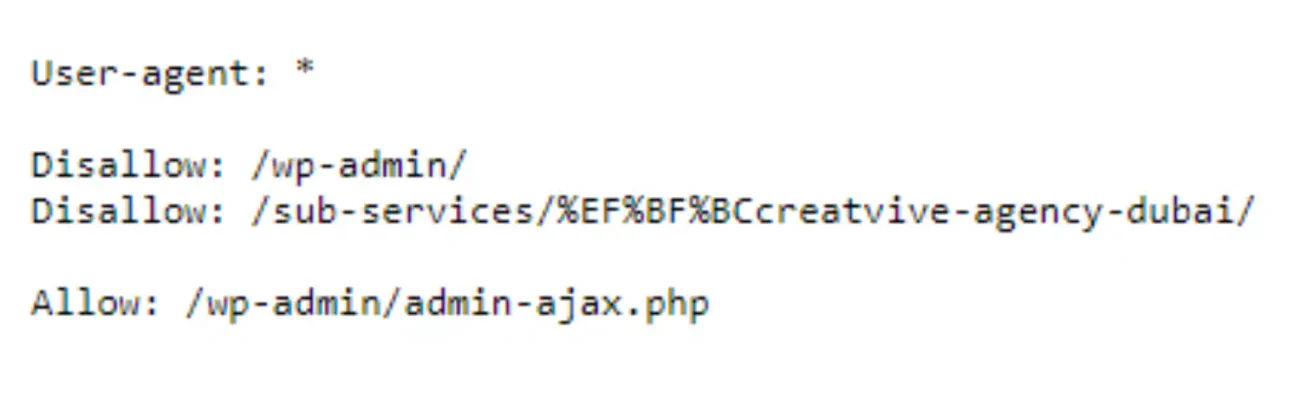
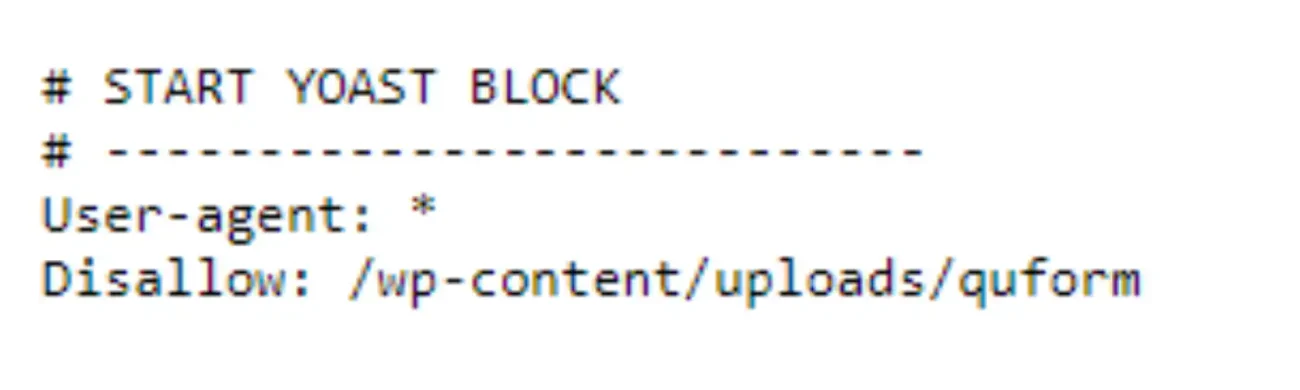
3. The “Lazy Proxy” / Default Plugin Trap
Agencies rely on default plugin-generated rules without manual governance.
They block inconsequential paths while leaving critical surfaces exposed:
/wp-json/REST API/?author=1user enumeration
This enables automated reconnaissance and credential targeting.
The perimeter is assumed, not engineered.
4. The Foreign Resource Drain (ROI Bleed)
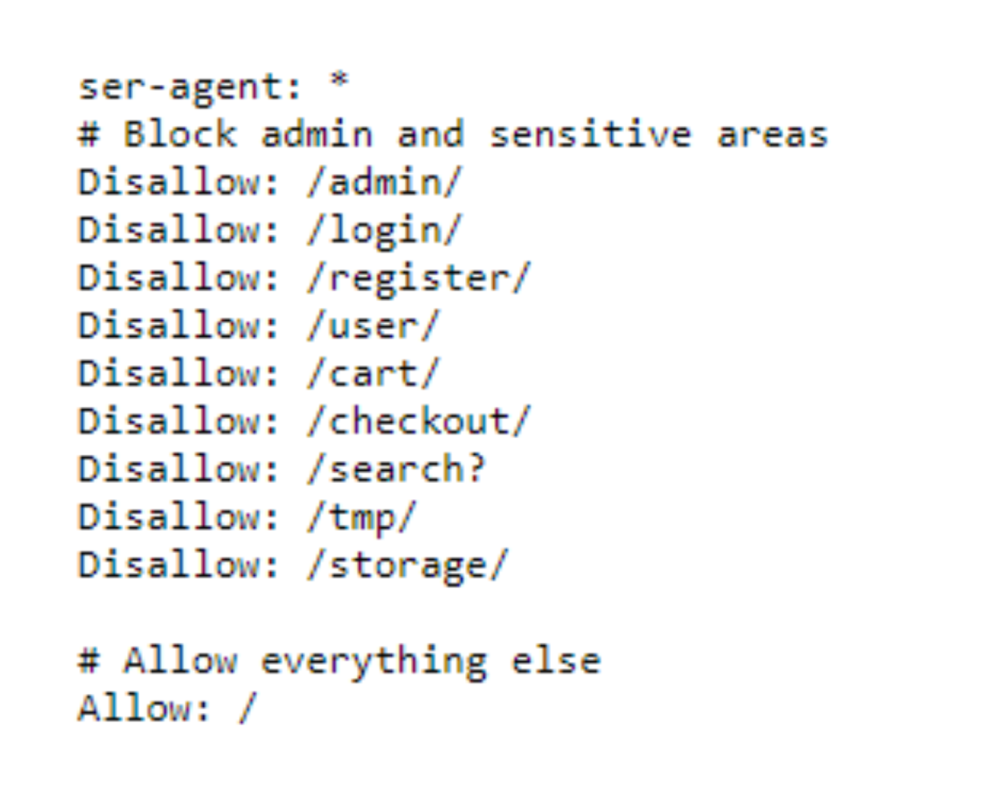
Unrestricted access is granted to non-revenue crawlers:
- Baidu
- Yandex
These agents consume measurable infrastructure capacity:
- Up to 40% CPU and RAM allocation
- Increased latency under load
- Inflated hosting expenditure
This is capital erosion.
This is a direct leak of UAE digital capital to irrelevant foreign infrastructures.
5. The “Illusion of Order” (Inconsistent Blocking)
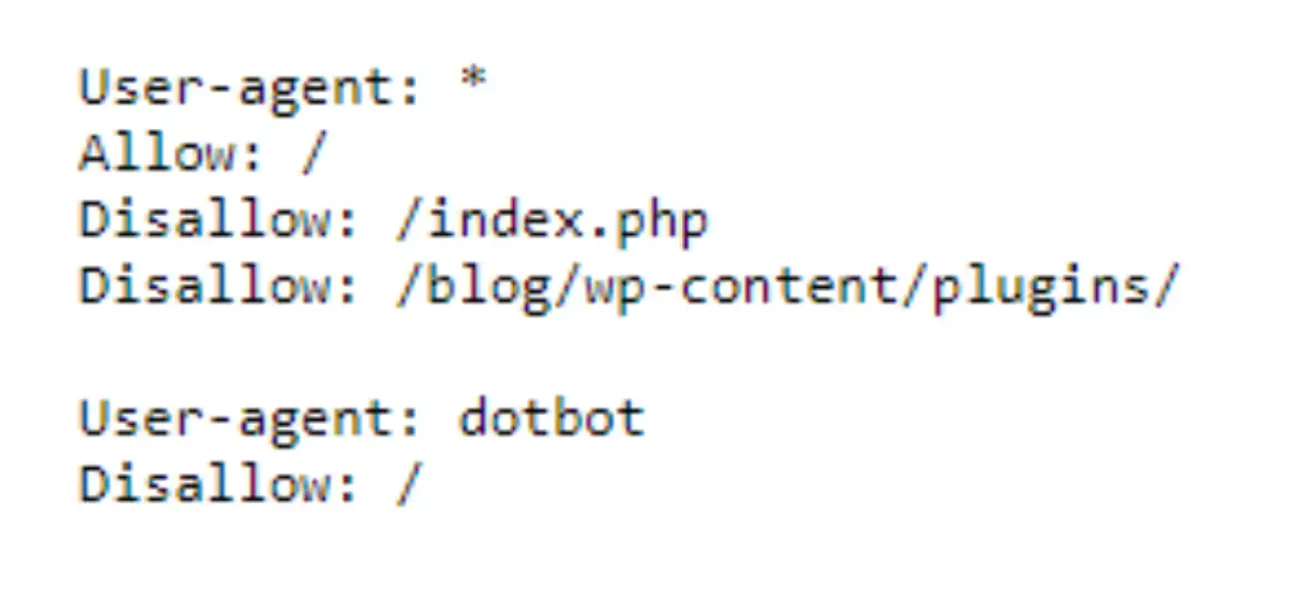
Selective blocking of low-impact bots creates false assurance:
- Minor agents restricted
- High-volume scrapers unrestricted
This is security theatre.
No classification. No hierarchy. No enforcement.
Financial Attrition & Security Vulnerability
Crawl Budget Exhaustion (Operational Degradation)
Crawl budget is not theoretical. It is a finite allocation of server resources and crawler attention.
Unregulated bot access introduces non-revenue-generating traffic from:
- AI training agents
- Foreign search engines (Baidu, Yandex)
- Aggressive data harvesters
These actors consume CPU cycles, saturate memory, and increase origin response latency.
The consequence chain is mechanical:
- Server resource contention increases
- Response times degrade
- Googlebot encounters intermittent timeouts
- Crawl frequency is reduced
- Indexation quality declines
This is not an SEO issue. It is infrastructure misallocation.
Revenue-impacting crawlers are throttled by non-revenue actors.
Intellectual Property Exposure (Model Ingestion Risk)
Publicly accessible content is no longer confined to human readership.
It is ingested, tokenised, and retained within external model architectures.
Without explicit crawler governance:
- Proprietary frameworks become training data
- Differentiation collapses into commodity outputs
- Competitive advantage is statistically diluted
There is no recall mechanism once ingestion occurs.
User Enumeration & Reconnaissance Surface
Default WordPress endpoints expose a secondary vulnerability layer:
/wp-json/wp/v2/users/?author=1
These vectors enable automated user enumeration.
The outcome:
- Identification of valid usernames
- Credential targeting through brute-force attempts
- Structured reconnaissance for privilege escalation
This is a known exploit pattern, not a theoretical risk.
Leaving these endpoints unprotected signals a lack of baseline security governance.
The Engineering Manifesto
The Sovereign Firewall
Legacy agencies operate under a false assumption: that all bots behave predictably.
They do not.
The core failure is an identity collapse—treating all crawlers as a homogeneous class.
They are not.
The AELION Protocol
We engineer a zero-leakage posture through layered enforcement.
1. Deterministic robots.txt Architecture
- Explicit denial of AI training agents (GPTBot, ClaudeBot, CCBot)
- Selective allowance for citation-oriented agents (e.g., OAI-SearchBot)
- Segmentation of crawl directives by intent, not by default
This is not blocking. It is classification.
2. Faceted Navigation Suppression
- Elimination of parameter-based crawl traps
- Prevention of infinite URL permutations
- Preservation of crawl budget for revenue-critical pages
3. Edge-Based Crawler Enforcement (Non-Negotiable)
robots.txt is advisory. Malicious actors ignore it.
We enforce policy at the edge layer:
- WAF-level user-agent validation
- Behavioural rate limiting
- IP reputation filtering
- Bot fingerprinting beyond declared identity
This is where control is asserted.
Not at the application layer. At the perimeter.
4. Live Infrastructure Audit
We do not rely on theoretical governance. Our perimeter defense is active, measurable, and publicly verifiable.
The Organisational Infrastructure
The Tri-Nodal Model
This level of governance cannot be achieved through fragmented teams.
It requires structural alignment.
London — Governance Authority
- Data sovereignty enforcement
- Legal alignment with UAE PDPL
- IP protection frameworks
- Audit control and architectural sign-off
Dubai — Market Strategy
- Commercial alignment with GCC enterprise requirements
- Deployment calibration for regional platforms
- Executive interfacing and mandate definition
Casablanca — Intelligence & Security Hub
- High-density concentration of elite infrastructure engineers and security architects executing controlled, verifiable perimeters.
- Dedicated crawler governance engineering
- Performance instrumentation and threat monitoring
This is not outsourcing.
It is controlled capital efficiency.
Verified Intelligence Sources
- Cloudflare Data: The Crawl-to-Click Gap (AI Bots vs. Referrals)
- AI / LLM User-Agents Enterprise Blocking Guide
- CVE-2017-5487 – User Enumeration Exploit Analysis
Directive
The AELION Protocol for IP protection auditing is not advisory.
For enterprise platforms operating within the GCC, it is mandatory.
