
Compliant Enterprise Headless Architecture in the GCC: A Strategic Governance Briefing


- The Architecture of Compliant Enterprise Content Infrastructure in the GCC
- I. Executive Summary: The Complexity of GCC Digital Transformation
- 1.1 The Acceleration of Regional Complexity
- 1.2 Multi-Channel Content & Governance Pressures
- 1.3 The Technical Liability of Legacy Infrastructure
- 1.4 The Transition to Regulatory Exposure
- II. Sovereign Risk & Compliance Architecture: The Regulatory Matrix
- 2.1 Jurisdictional Asymmetry: Mainland vs. Financial Free Zones
- 2.2 Sector-Specific Data Localization Mandates
- 2.3 Vendor Liability and Deconstructing “Sovereignty Washing”
- 2.4 The Executive Penalty Matrix
- III. Regional Infrastructure Considerations & Performance Engineering
- 3.1 Edge Network Topography in the MENA Region
- 3.2 The Headless Migration Trap and API Latency
- 3.3 Bilingual (Arabic/English) Configuration Anomalies
- 3.4 Typography and Right-to-Left (RTL) Layout Constraints
- IV. Common Architecture Risks in Headless Implementations
- 4.1 Post-Facto Governance Design
- 4.2 Delayed Arabic Localisation Integration
- 4.3 Ungoverned API Ecosystems
- 4.4 Superficial Frontend Masking
- 4.5 Retrospective Compliance Auditing
- V. Decoupled Architecture: Node.js Infrastructure Layer Selection
- 5.1 Architectural Selection Criteria
- 5.2 Decoupled Content Modelling & Bilingual Efficiency
- 5.3 Granular Governance & Access Control Systems
- VI. Enterprise Decision Framework
- 6.1 When an Open-Source, Self-Hosted Core May Be Appropriate
- 6.2 When a Self-Hosted Enterprise Solution May Not Be Appropriate
- VII. Distributed Governance: An Operational Model
- 7.1 A Three-Node Governance Model
- VIII. Search Intent & Generative Engine Optimisation: The GEO Framework
- 8.1 Information Gain and Entity Density
- 8.2 The BLUF (Bottom Line Up Front) Architecture
- 8.3 E-E-A-T Structural Integration
- IX. Strategic Response Module: GCC Enterprise Queries
- 9.1 Does the UAE PDPL mandate data localisation?
- 9.2 What is the capital expenditure for enterprise headless migration?
- 9.3 How long must corporate e-invoicing and digital tax records be retained in the UAE?
- 9.4 How can a business assess whether its content infrastructure has sufficient information gain?
- X. Appendix & Reference Sources
- Regulatory and Governance Frameworks
- Technical and Industry Standards
- Reference Note
STRATEGIC INTELLIGENCE BRIEFING
The Architecture of Compliant Enterprise Content Infrastructure in the GCC
I. Executive Summary: The Complexity of GCC Digital Transformation
1.1 The Acceleration of Regional Complexity
GCC enterprises operate under regulatory frameworks that have tightened substantially. Saudi Vision 2030 and the UAE AI Strategy 2031 represent formal commitments to digital modernisation. Organisations must now support omnichannel customer interaction: web properties, native mobile applications, digital kiosks, customer portals, and AI-enabled interfaces.
Many regional enterprises operate infrastructure that was designed for single-channel desktop delivery. That architecture may create constraints when extended to multiple channels.
1.2 Multi-Channel Content & Governance Pressures
Managing content across multiple channels while maintaining brand consistency, legal compliance, and operational velocity is structurally more complex than single-channel delivery. A content update must flow reliably through web rendering engines, mobile application SDKs, third-party partner portals, and AI agent interfaces—each with different performance requirements and regulatory constraints.
Data protection regulation, sector-specific localisation mandates, and audit requirements now demand transparent, traceable content workflows. Legacy monolithic systems may not be able to provide this visibility without substantial retrofit engineering.

1.3 The Technical Liability of Legacy Infrastructure
Monolithic enterprise systems—typically built around centralised databases, tightly coupled presentation layers, and single-deployment pipelines—were engineered when digital footprints were smaller and change velocity was lower.
When extended to multiple channels, these systems can create operational friction:
- Content updates may require full system deployments, creating downtime risk
- API layers may not exist, requiring frontend engineers to access databases directly
- Multi-language support is often added without native schema integration
- Governance and access control may operate at coarse role levels, limiting granular security
- Performance may degrade under concurrent traffic spikes when all layers share infrastructure
These constraints can elevate operational cost and direct IT resources toward stability work rather than strategic development.
1.4 The Transition to Regulatory Exposure
Data protection and sector-specific compliance frameworks—particularly in the UAE, Saudi Arabia, and other GCC jurisdictions—treat infrastructure topology as a regulatory question, not merely a technical one.
Legacy systems may not meet this standard because:
- They may not track data lineage with sufficient granularity for audit purposes
- They may commingle governed data (financial records, health information) with operational data without clear separation
- They may not support geographic data localisation requirements without manual processes
- They may lack the API infrastructure needed to enforce least-privilege access controls for external integrations
Regulatory bodies in several GCC jurisdictions now expect organisations to demonstrate that their systems were designed with compliance as an architectural requirement. Organisations should assess their current infrastructure against applicable regulatory frameworks and obtain qualified legal advice where gaps may exist.
II. Sovereign Risk & Compliance Architecture: The Regulatory Matrix
2.1 Jurisdictional Asymmetry: Mainland vs. Financial Free Zones
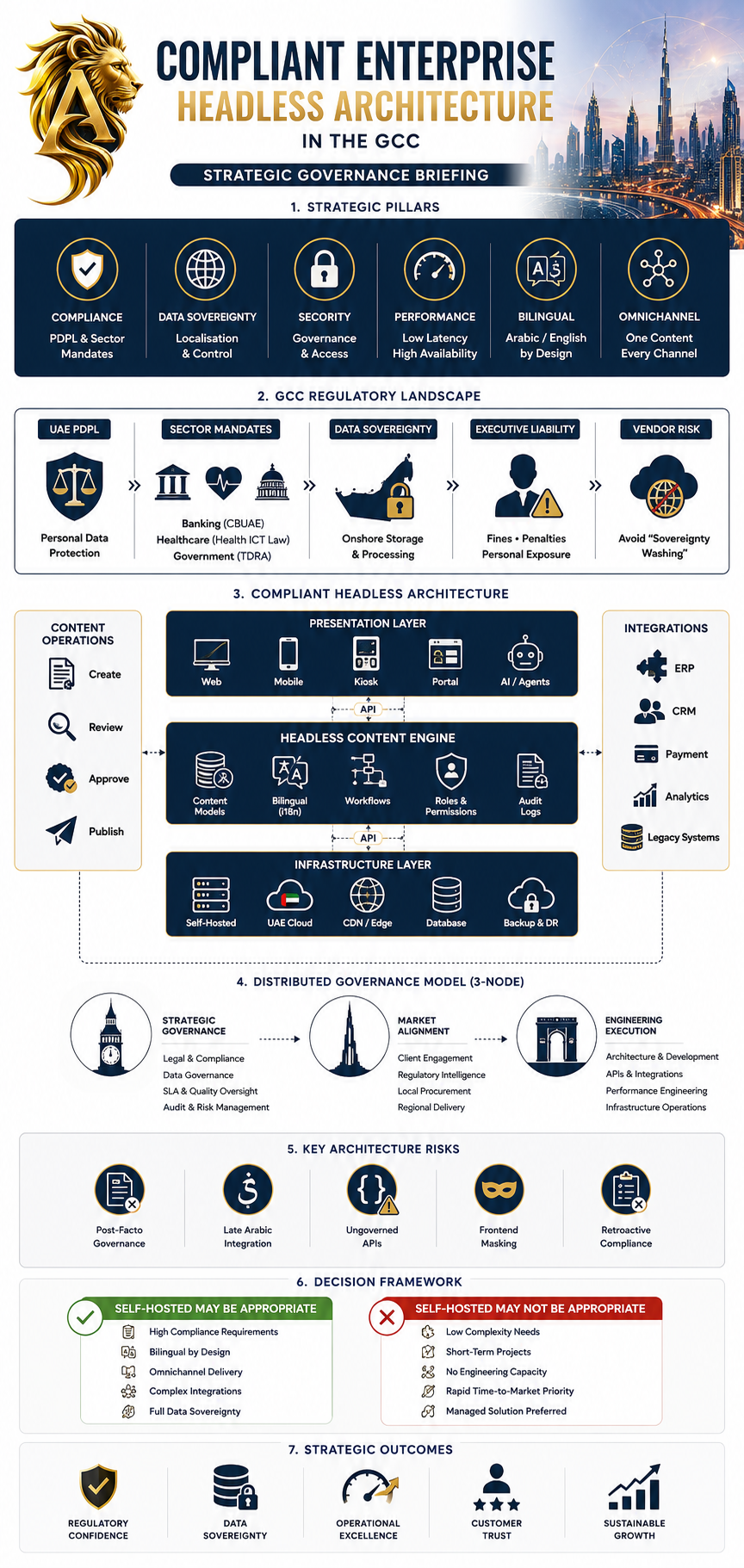
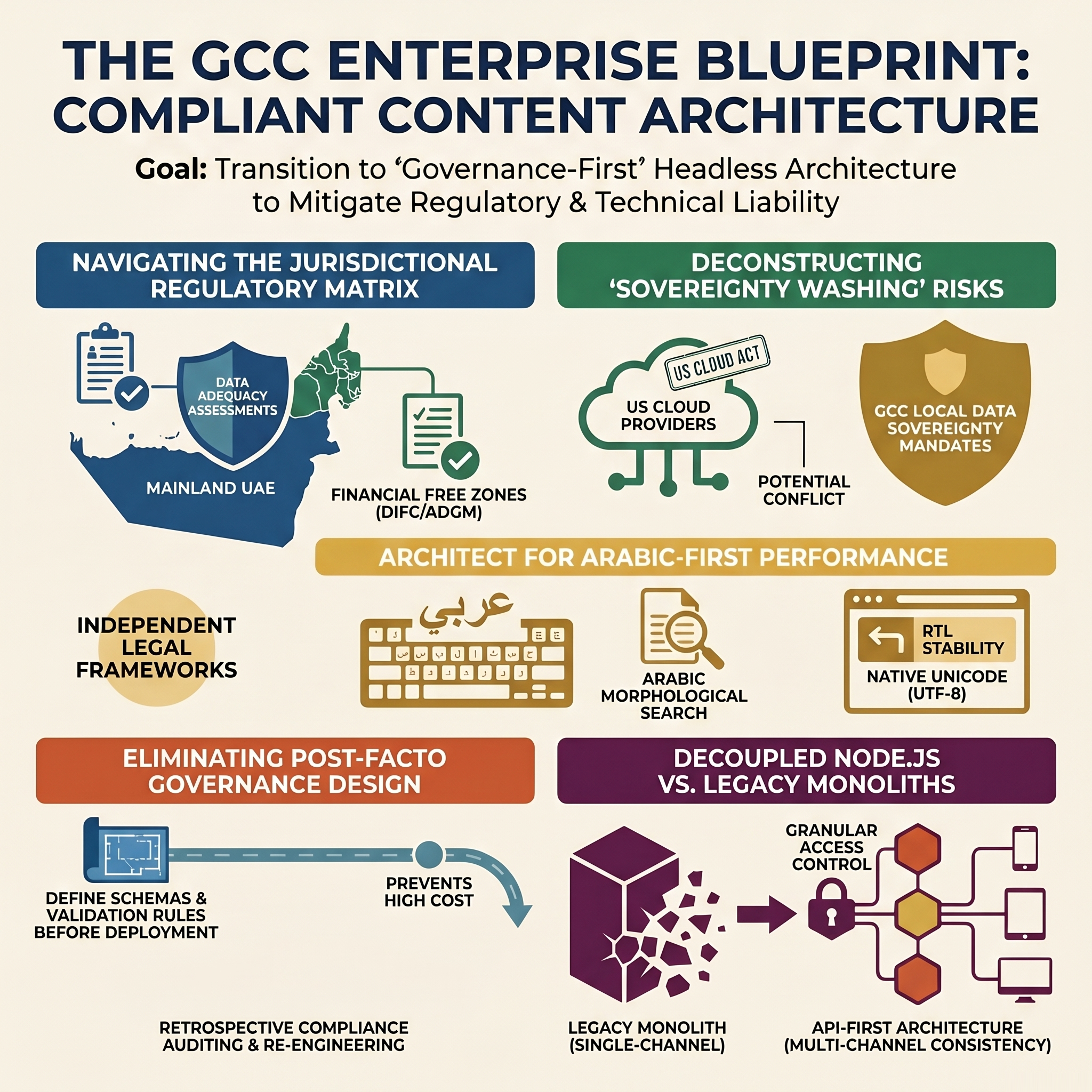
The UAE presents a structural regulatory complexity that requires explicit technical assessment. The Dubai International Financial Centre (DIFC) and Abu Dhabi Global Market (ADGM) operate under independent legal frameworks. Neither automatically treats UAE mainland as an “adequate jurisdiction” under their respective data protection standards.
This creates a practical constraint: a corporate entity registered in the DIFC that transfers data to a mainland data repository may need to document that transfer as a cross-border movement and establish its compliance posture under the relevant free zone data protection act. Organisations should obtain qualified legal advice on how this applies to their specific structure.
Technical Considerations:
- Data transfers between DIFC-registered corporate entities and mainland-operated infrastructure may require documented adequacy assessments
- Internal shared-service arrangements between DIFC and mainland divisions may need to establish contractual data processing terms
- Cloud infrastructure hosted on UAE mainland may require explicit legal classification as either first-party operations or third-party vendor arrangements
Organisations cannot assume that physical proximity eliminates jurisdictional complexity. The applicable regulatory frameworks address this scenario and should be reviewed with qualified legal counsel.
2.2 Sector-Specific Data Localization Mandates
Data localisation requirements vary by sector. The UAE Personal Data Protection Law (PDPL) does not mandate universal localisation. However, sector-specific frameworks impose mandatory localisation for critical data categories. Organisations should assess which frameworks apply to their activities.
Banking & Financial Services:
The UAE Central Bank (CBUAE) Consumer Protection Standards set requirements for core customer records—including account data, transaction histories, and personal identification. Organisations in this sector should assess whether their architecture ensures that relevant data remains within UAE borders and obtain qualified advice on how CBUAE requirements apply to their specific systems.
Healthcare:
Federal Law No. 2 of 2019 (Health ICT Law) addresses transmission of health data outside UAE borders. Organisations operating healthcare platforms should classify health-related data flows at the schema level and seek qualified legal advice on how this law applies to their data architecture.
Digital Government & Public Administration:
The Telecommunications and Digital Government Regulatory Authority (TDRA) National Cloud Security Policy sets requirements for government-facing systems. Organisations providing digital services to government entities or handling government-related data should assess their compliance with this policy directly.
2.3 Vendor Liability and Deconstructing “Sovereignty Washing”
Global cloud service providers may market “local data centres” and “regional compliance” in ways that conflate physical infrastructure location with legal data sovereignty. Organisations should assess these claims carefully.
The US CLOUD Act Exposure:
Major US-headquartered cloud providers maintain administrative access rights—documented in their terms of service—that may be subject to US legal process, regardless of where data physically resides. Under the US CLOUD Act, US authorities may compel disclosure of data stored on US-controlled infrastructure, even when that infrastructure is geographically located outside the United States.
GCC organisations should assess whether UAE-based data centres operated by US-headquartered companies meet their specific sovereignty requirements, and obtain qualified legal advice on this question.
Accredited Service Provider (ASP) Liability:
Under PDPL and other GCC frameworks, appointing an external vendor as an Accredited Service Provider does not transfer legal liability. The appointing organisation remains legally responsible for PDPL compliance, data breach notification, and regulatory cooperation—regardless of what the vendor contract states.
Organisations cannot transfer compliance risk through vendor appointment alone. They should independently verify that vendors’ technical controls and legal jurisdictions align with regulatory requirements.
Technical Consideration:
Organisations may need to architect infrastructure in ways that do not create dependency on vendor-managed compliance. In some cases, this may mean self-hosting critical data layers on UAE-registered cloud infrastructure, accepting higher operational overhead in exchange for clearer legal accountability.
2.4 The Executive Penalty Matrix
Non-compliance with PDPL may carry material financial and personal consequences. Organisations should assess their exposure with qualified legal and governance advisors.
Administrative Penalties:
The PDPL framework provides for administrative fines. Organisations should review the current penalty provisions directly within the published legislation and assess their exposure accordingly.
Personal Executive Liability:
Senior officers and board members may face personal liability for decisions that knowingly accepted compliance risk. Organisations should seek qualified legal advice on how executive liability provisions apply in their jurisdiction.
DIFC Private Right of Action:
DIFC Amendment Law No. 1 of 2025 introduces a private right of action for privacy violations within DIFC Courts, allowing individuals to bring claims directly in addition to any regulatory action. Organisations operating within the DIFC should review this development with DIFC-qualified legal advisors.
Operational Consideration:
Board-level technology governance documentation should include the regulatory frameworks that informed infrastructure decisions and the technical controls that address specific compliance requirements.
III. Regional Infrastructure Considerations & Performance Engineering
3.1 Edge Network Topography in the MENA Region
Geographic Infrastructure Proximity:
Enterprise infrastructure performance is constrained by geography. Infrastructure proximity to end users affects user experience, and this principle applies to GCC deployments as it does elsewhere. Regional cloud infrastructure located in the Middle East will generally offer lower latency to GCC end users than infrastructure located in Western Europe or North America.
Technical Consideration:
Content Delivery Networks (CDNs) can cache static assets effectively, but dynamic and personalised content requires backend infrastructure proximity to end users. Organisations should assess where their backend infrastructure is located and whether that placement is consistent with their performance and compliance requirements.
3.2 The Headless Migration Trap and API Latency
Many GCC organisations have migrated from monolithic systems to headless architectures to support agility and multi-channel delivery. Poorly executed migrations can result in performance degradation relative to the original monolith. This is a recognised risk in enterprise architecture, not a condition unique to any region.
Root Cause: Implementation Errors
The technical problems are well-documented in enterprise software engineering literature:
Over-hydration of Static Components: Unnecessary data fetching during initial page load can introduce delays. Where the same content could be delivered through optimised queries, excessive API calls during Server-Side Rendering (SSR) introduce avoidable overhead.
Sequential vs. Parallel Execution: Unoptimised API orchestration that executes requests sequentially rather than in parallel increases render time. Request orchestration design materially affects render performance.
Inadequate Caching Strategy: Without a defined caching strategy, content that could be cached may be re-fetched on each request, creating unnecessary database load.
Performance Assurance:
Organisations migrating to headless architectures should establish Core Web Vitals (CWV) baselines from the existing system. New headless implementations should meet or exceed those baselines before production deployment.
Recommended Approach:
Headless migrations require architecture-level performance optimisation from inception. This includes query consolidation, caching strategy definition, and frontend component hydration discipline.
3.3 Bilingual (Arabic/English) Configuration Anomalies
Multi-language support in the GCC context is not merely a translation workflow problem. It is a technical architecture problem that affects database design, search indexing, API payload structure, and frontend rendering.
Database-Level Prerequisites:
Enterprise databases should implement native Unicode (UTF-8) encoding at all layers. This is documented in the Unicode Consortium standard and includes:
- Collation rules configured for Arabic text ordering
- Index structures optimised for Arabic character sequences
- Full-text search engines capable of processing Arabic morphology
Databases configured with single-byte character encoding (ISO-8859-1, Windows-1252) are not designed to handle Arabic diacritics, ligatures, and position-dependent glyphs. Retrofitting Unicode support to such systems is complex and error-prone.
Search Indexing Limitations for Arabic Text:
Standard English-language search indexes are not designed for Arabic text. Known limitations include:
- Arabic diacritical marks (tashkeel) are often omitted by users but carry semantic meaning; standard indexes may not resolve variants
- Arabic ligatures may be indexed as separate characters rather than unified glyphs
- Position-dependent glyphs, which change shape depending on their position in a word, may not be handled correctly
- Morphological variants (singular, dual, plural; masculine, feminine) may be indexed as entirely separate terms
Search results in Arabic may be incomplete or unreliable unless the search engine is explicitly configured for Arabic morphology and diacritic handling.
Technical Approach:
- Configure database collation and full-text search explicitly for Arabic
- Use search engines with native Arabic morphological analysis (Elasticsearch with Arabic plugin, Solr with Arabic stemmer, or equivalent)
- Test search functionality with user-generated Arabic text before production deployment
3.4 Typography and Right-to-Left (RTL) Layout Constraints
RTL layout introduces specific typography and layout engineering requirements that cannot be addressed through CSS mirroring alone. These are documented in W3C internationalisation guidelines.
Layout Considerations:
Arabic text typically requires more horizontal space than equivalent English text. Layout systems designed for English baseline widths may need adjustment to accommodate Arabic proportions reliably.
Vertical Line-Height Considerations:
Arabic typography requires more vertical line-height spacing than English. Arabic characters have descenders and tails that extend below the baseline. Standard English line-height defaults may result in character overlap in Arabic. RTL stylesheets should specify line-height values appropriate for Arabic typography.
CSS and JavaScript Mirroring Limitations:
Implementing RTL through CSS transforms alone (scale(-1, 1)) or margin reversals can produce predictable failures, including:
- Scrollable containers (carousels, sliders) that mirror in ways that break interaction patterns
- Text direction properties that remain incorrect, affecting accessibility for screen reader users
- Directional inputs (number spinners, date pickers) that become unintuitive
- JavaScript event handlers for drag-and-drop and gesture controls that may produce incorrect behaviour due to coordinate mapping
Recommended Approach:
- Explicit dir=”rtl” attributes in HTML markup
- CSS written using logical properties (margin-inline-start, margin-inline-end) rather than directional properties
- JavaScript event handlers designed to account for RTL coordinate systems
- Separate testing and QA cycles for RTL rendering
Treating Arabic RTL as a first-class architectural requirement from inception is generally less complex than retrofitting RTL support to an English-first codebase.
IV. Common Architecture Risks in Headless Implementations
This section outlines architectural patterns that can introduce risk in headless content infrastructure. Organisations should assess each pattern against their own implementation.
4.1 Post-Facto Governance Design
Headless infrastructure deployed without predefined schema validation workflows may result in governance frameworks being designed retrospectively, after content has been created and published.
Potential Consequences:
- Inconsistent content models across different content types
- Absence of validation rules for mandatory fields
- No audit trails for content modifications
- Uncontrolled proliferation of custom field types and extensions
- Inability to enforce brand guidelines or regulatory compliance rules at content creation time
Remediation Considerations:
Remediating governance gaps after deployment may require re-engineering effort, including revalidating existing content and redesigning schema structures. This is generally more complex and costly than establishing governance design before implementation begins.
Recommended Approach: Content schema design should precede content creation. Governance requirements—including validation rules, access controls, audit trails, and approval workflows—should be defined as part of the initial architecture design.
4.2 Delayed Arabic Localisation Integration
Where Arabic localisation is treated as a translation layer to be added after English content infrastructure is complete, structural problems can arise.
Potential Consequences:
- Bilingual content models that do not account for RTL text expansion
- Database schema optimised for English single-language workflows
- API responses structured around English-first retrieval patterns
- Frontend components built without RTL layout considerations
- Content editor interfaces that are poorly suited to Arabic editors
Recommended Approach: Bilingual infrastructure should be architected from inception. Content models, database schema, API response structures, and frontend components should all be designed to support parallel Arabic and English content flows.
4.3 Ungoverned API Ecosystems
Headless infrastructure deployed with APIs that lack explicit token scoping or Role-Based Access Control (RBAC)—designed only around binary authenticated and unauthenticated states—may create security and governance risks.
Potential Consequences:
- Authenticated frontends may be able to access all content and trigger any mutation
- Mobile applications sharing API credentials make breach attribution difficult
- Third-party integrations may not be limited to specific content types or operations
- Serialisation errors in one integration may affect other downstream consumers
- APIs returning unnecessary fields may cause payload inflation
Recommended Approach: API design should include explicit scope definitions before implementation. Each API endpoint should specify which roles can access it and what operations are permitted. Token generation should include scoping information validated on each request.
4.4 Superficial Frontend Masking
Where performant frontend interfaces are built over fragmented or poorly optimised backend services, underlying performance problems may not be visible during initial deployment and testing.
Potential Consequences:
- Frontend caching and optimistic updates may obscure backend performance problems
- Database instability under concurrent transaction spikes may go undiagnosed
- Scalability problems may emerge after launch when traffic increases
- Remediation may require fundamental backend redesign
Recommended Approach: Performance testing should include both frontend and backend metrics. Load testing with realistic concurrent user volumes should be conducted during pre-production phases. Critical paths—content retrieval, user authentication, transaction processing—should be tested under stress conditions before production deployment.
4.5 Retrospective Compliance Auditing
Where data sovereignty and security compliance reviews are conducted after infrastructure configuration is complete, hosting placement errors or regulatory gaps may be identified only after deployment—requiring re-engineering.
Potential Consequences:
- Infrastructure hosted in non-compliant geographic regions may require migration
- Data localisation gaps may require remediation
- Vendor arrangements may require restructuring to meet regulatory standards
- Project schedules and budgets may be materially affected
Recommended Approach: Compliance review should occur during the architecture design phase. Organisations should engage regulatory advisors during infrastructure planning to ensure that hosting, data flows, and vendor relationships align with legal requirements before engineering begins.
V. Decoupled Architecture: Node.js Infrastructure Layer Selection
The transition from monolithic to decoupled architecture requires careful selection of core infrastructure components. Node.js-based headless content engines are a commonly used technical foundation for enterprise content infrastructure.
5.1 Architectural Selection Criteria
Node.js presents several characteristics relevant to GCC regional infrastructure:
Language Availability: Node.js development relies on JavaScript, which is broadly used across enterprise engineering markets, including the GCC.
Library Ecosystem: The Node.js ecosystem includes established libraries for content management (schema validation, versioning, publishing workflows), API development (Express, Fastify), and middleware operations (authentication, authorisation, rate limiting).
Geographic Deployment: Node.js applications can be deployed on UAE and Saudi Arabia regional cloud infrastructure (Google Cloud Middle East, AWS Middle East, Microsoft Azure Middle East) without platform-specific constraints.
Performance Characteristics: For content delivery and API operations, Node.js can provide adequate performance for many enterprise use cases, particularly when paired with appropriate database and caching layers.
Limitations: Node.js is not designed for compute-intensive operations such as image processing, large document parsing, or cryptographic operations. Organisations requiring these capabilities should use purpose-built services rather than executing them within Node.js runtime.
5.2 Decoupled Content Modelling & Bilingual Efficiency
Enterprise headless systems serving bilingual audiences should structure content and queries to avoid the latency associated with sequential API calls for each language variant.
Current Technical Standard: Resource Dictionary Schema (i18n)
Rather than storing English and Arabic as separate documents or requiring separate API calls, modern headless systems can use a single document with nested localisation objects:
{
  id: "homepage-hero",
  type: "hero-section",
  content: {
    en: {
      headline: "Welcome to our platform",
      body: "Discover our services..."
    },
    ar: {
      headline: "أهلاً بك في منصتنا",
      body: "اكتشف خدماتنا..."
    }
  },
  metadata: {
    publishedAt: "2024-01-15",
    lastModified: "2024-06-01"
  }
}
Parallel Fetching:
Fetching the core document and all localised variants simultaneously in a single query avoids the latency penalty of sequential language-specific requests. Query design should:
- Retrieve both language variants in a single database round-trip
- Index content simultaneously for both languages
- Cache the complete bilingual document as a single unit
This approach reduces database round-trips compared to sequential bilingual queries.
5.3 Granular Governance & Access Control Systems
Enterprise content workflows may require access control more granular than broad role-based systems. Least-privilege permissions at the level of individual operations and integrations are increasingly relevant in multi-channel and multi-tenant environments.
Traditional RBAC Limitations:
Standard role-based access control assigns broad permissions to user roles. A user granted an “Editor” role may be able to create and modify any content of any type. This may be insufficient in environments where:
- Different content types require different approval workflows
- AI agents or automated tools should access only specific content types
- Third-party integrations should be limited to particular operations
- Audit requirements demand full visibility into who made what changes and when
Contextual, Least-Privilege Permissions:
Modern systems can evaluate permissions based on:
- Content type being accessed
- Specific operation (create, read, update, delete, publish)
- User identity or API token scope
- Temporal constraints (access valid only during specific time windows)
- Contextual factors (geographic location, network conditions)
Illustrative Design Pattern:
Organisations managing bilingual content across multiple channels may structure permission systems to allow:
- Editors to create Arabic content only within designated content types
- Translators to modify existing translations without creating new content
- AI agents to retrieve only published content, without draft access
- Mobile applications to retrieve public content via limited API tokens that cannot trigger mutations
- Compliance administrators to audit all changes without modifying content
Technical Requirement:
Headless content systems should provide extensible RBAC frameworks allowing organisations to define custom permission rules without forking code or building custom middleware. Flexible, self-hosted content systems such as Strapi provide this extensibility through configuration rather than code modification.
VI. Enterprise Decision Framework
Not all organisations should implement self-hosted, decoupled content infrastructure. The framework below outlines organisational profiles for which this approach may or may not be appropriate.
6.1 When an Open-Source, Self-Hosted Core May Be Appropriate
Multi-Language Operations:
Organisations managing native, parallel operations in Arabic and English may find that platforms built around English-first architectures require substantial customisation to support Arabic properly. Self-hosted systems can allow organisations to:
- Define bilingual content schemas that treat Arabic and English equally
- Implement bilingual search indexing without reliance on third-party translation plugins
- Manage Arabic-specific governance workflows (RTL content review, diacritic handling)
- Maintain full audit visibility across bilingual content workflows
Omnichannel Distribution:
Enterprises distributing content across multiple channels—web, native mobile applications, digital kiosks, customer portals, internal systems—may benefit from a single system that serves all channels rather than separate content management systems for each. Potential advantages include:
- Content updates that propagate to all channels from a single operation
- Governance rules applied consistently across channels
- Analytics and reporting based on unified content metadata
- Brand consistency enforced at infrastructure level
High Governance & Compliance Requirements:
Organisations required to operate self-hosted infrastructure on localised UAE sovereign clouds to meet PDPL, CBUAE, TDRA, or other regulatory requirements may not be able to satisfy those requirements using managed SaaS platforms. Self-hosted infrastructure can provide:
- Control over data location and replication
- Audit trails showing data storage and access
- Ability to segregate governed data from operational data
- Direct demonstrability of compliance during regulatory audits
API-First Architecture:
Organisations requiring integration with complex backend middleware, legacy ERPs, or commerce engines may benefit from content infrastructure that prioritises APIs. Self-hosted systems can be architected to expose APIs that integrate with enterprise middleware. API contracts should be defined before implementation to prevent database schema details from leaking into API responses.
6.2 When a Self-Hosted Enterprise Solution May Not Be Appropriate
Low-Complexity Websites:
Small brochure or marketing sites with static content and minimal integration requirements may not justify the operational overhead of self-hosted infrastructure. Managed platforms such as Webflow, hosted WordPress, or static site generators with content editing layers may better suit these requirements.
Short-Term Deployments:
Projects requiring rapid, templated launches where long-term total cost of ownership is not a priority may be better served by managed solutions. Building custom self-hosted infrastructure for short-duration projects is likely to be economically inefficient.
Non-Technical Teams:
Organisations without the internal engineering capacity or external support to manage API-first environments and frontend routing should not implement self-hosted headless systems. The operational requirements are substantial:
- Schema design and API contract definition
- Infrastructure provisioning and maintenance
- Security patching and dependency updates
- Performance monitoring and optimisation
- Troubleshooting multi-system interactions
Organisations without this capacity should select managed platforms that handle this complexity through the service model.
VII. Distributed Governance: An Operational Model
Organisations delivering enterprise technical infrastructure across geographies may need to allocate responsibilities deliberately across locations to manage cost and maintain governance quality.
7.1 A Three-Node Governance Model
The following structure represents one approach to distributing governance, commercial, and engineering responsibilities across locations. It is presented as an analytical model.
Strategic Governance Node:
A governance-focused location—for example, London—may serve as the centre for legal framework management, data governance compliance, and international SLA oversight. Responsibilities in this model would include:
- Regulatory compliance interpretation and strategic alignment
- Data protection framework design and audit coordination
- Vendor contract review and compliance obligation documentation
- International legal and regulatory liaison
- Quality assurance and delivery standards definition
Locating governance responsibilities in a jurisdiction with established access to international regulatory precedent and legal expertise may support more rigorous compliance management.
Market Alignment Node:
A regionally proximate location—for example, Dubai—may serve as the centre for enterprise engagement and GCC-specific market intelligence. Responsibilities in this model would include:
- Client relationship management and executive engagement
- GCC regulatory intelligence and market monitoring
- Local procurement process management
- Regional delivery coordination
Proximity to GCC clients and regulatory bodies supports alignment with local requirements and procurement processes.
Engineering Execution Node:
An engineering-focused location—for example, Casablanca—may serve as the centre for technical implementation. Responsibilities in this model would include:
- Technical architecture design and schema definition
- Implementation and API development
- Database optimisation and query design
- Bilingual infrastructure engineering
- Performance engineering and load testing
- Infrastructure deployment and operations
Geographic labour market variations across these three nodes allow organisations to allocate talent based on specialist requirements. Organisations should assess this model against their own operational requirements and regulatory obligations.
VIII. Search Intent & Generative Engine Optimisation: The GEO Framework
AI retrieval systems—including Google Search Generative Experience, large language model interfaces, and AI-powered research tools—have specific structural requirements for information accessibility. Organisations publishing enterprise content should consider these requirements when designing their content infrastructure.
8.1 Information Gain and Entity Density
Information Enrichment:
Content that performs well in AI retrieval is typically grounded in specific, verifiable information rather than generic analysis. Named regulatory references, technical terminology, and definitive responses to specific questions anchor content within machine knowledge representations.
Well-structured enterprise content should include:
- Specific regulatory references with statutory citation numbers
- Technical architecture analysis grounded in published standards
- Measured language that acknowledges areas of uncertainty
- Direct responses to the questions decision-makers are likely to ask
Contextual Entity References:
References to named regulatory bodies—such as “CBUAE Consumer Protection Standards,” “TDRA National Cloud Security Policy,” and “DIFC Amendment Law No. 1 of 2025″—create explicit entity connections that AI retrieval systems use to classify and surface content in response to relevant queries.
8.2 The BLUF (Bottom Line Up Front) Architecture
Information Prioritisation:
AI retrieval systems frequently process the early sections of documents with greater weight. Structuring content so that the direct answer to a section’s primary question appears immediately below the heading—rather than after contextual framing—supports both AI extraction and executive readability.
Machine Extraction Formatting:
Question-led headings followed immediately by direct, clinical answers allow AI systems to:
- Identify the primary query intent from heading text
- Extract the core answer from the immediately following paragraph
- Cite the source with a specific section reference
8.3 E-E-A-T Structural Integration
Experience, Expertise, Authoritativeness, and Trustworthiness (E-E-A-T) are criteria used by modern information retrieval systems to assess content quality.
Expertise:
Technical recommendations grounded in specific regulatory frameworks (PDPL, CBUAE standards, Health ICT Law) and engineering practices (UTF-8 collation, Arabic morphological analysis, RTL layout engineering) demonstrate domain familiarity through specificity rather than assertion.
Authoritativeness:
Grounding in published regulatory frameworks and technical standards, rather than undocumented experience claims, supports independent verification by readers and retrieval systems alike.
Trustworthiness:
Explicit legal disclaimers, acknowledgement of areas requiring qualified professional advice, and avoidance of absolute legal conclusions are markers of trustworthiness. Using measured language—”may require,” “subject to regulatory interpretation,” “organisations should obtain qualified legal advice”—is both accurate and credibility-preserving.
IX. Strategic Response Module: GCC Enterprise Queries
9.1 Does the UAE PDPL mandate data localisation?
The PDPL provides a unified data protection standard but does not impose blanket localisation. However, sector-specific frameworks impose mandatory localisation requirements for certain data categories.
Banking and financial institutions should assess their obligations under CBUAE Consumer Protection Standards with respect to core customer records. Healthcare providers should assess their obligations under Federal Law No. 2 of 2019 regarding health data. Government-facing organisations should review the TDRA National Cloud Security Policy directly.
Organisations cannot assume that PDPL alone determines their localisation obligations. Sector-specific regulation must be assessed separately, and qualified legal advice should be obtained.
9.2 What is the capital expenditure for enterprise headless migration?
Upfront custom schema engineering and API development carries higher baseline configuration costs than templated monolith deployments. Total cost of ownership depends on variables including system complexity, team capacity, infrastructure choices, and organisational scale.
Cost comparison should account for:
- Initial infrastructure and development costs
- Long-term maintenance overhead of legacy systems
- Security remediation costs associated with legacy architecture
- Ongoing team effort required for stability engineering
Break-even analysis is specific to each organisation. Organisations should model scenarios using their own financial and operational parameters. Qualified technology advisors should be engaged to support procurement decisions.
9.3 How long must corporate e-invoicing and digital tax records be retained in the UAE?
Under UAE Federal Tax Authority (FTA) requirements, VAT records and associated documentation must be retained for a minimum of five years. Organisations should review the current FTA guidance directly and obtain qualified advice on how retention requirements apply to their specific systems and data categories.
Organisations should consider what technical controls—audit logs, write-once storage, cryptographic verification—may be necessary to satisfy applicable immutability requirements. Qualified legal and technical advisors should be engaged to assess whether specific database configurations satisfy current regulatory standards.
9.4 How can a business assess whether its content infrastructure has sufficient information gain?
Enterprise content should be assessed against the following criteria before deployment:
- Specificity: Does the content reference specific regulations, technical standards, or verifiable facts? Generic analysis is likely to be deprioritised by AI retrieval systems.
- Direct Answers: Are the core answers to likely queries positioned early in each section, consistent with BLUF principles?
- Citable Structure: Are individual sections self-contained enough to be extracted and cited by AI systems independently of surrounding context?
- Preemptive Coverage: Does the content address downstream questions that a reader might have after reading a given section?
- Evidence-Based Positioning: Are claims supported by verifiable sources where evidence exists? Where evidence is unavailable, does the content use measured language (may, can, often, typically) to reflect uncertainty accurately?
