
Architecting High-Availability Commerce for UAE Peak Seasons

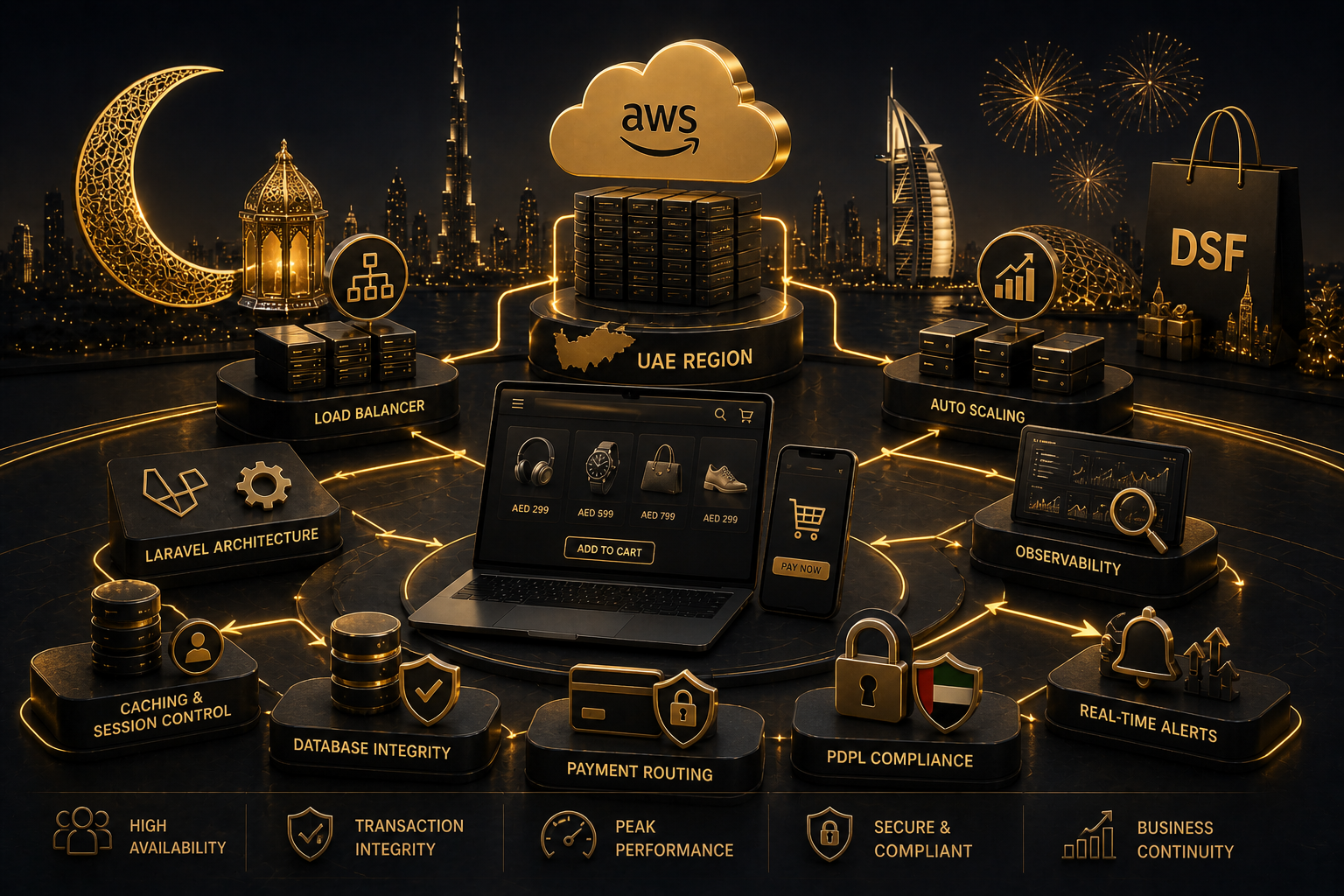
- Executive Summary
- Core Analysis
- Peak Load Reality — Non-Linear Traffic Events
- AWS Onshore Infrastructure — Load Distribution Control
- Laravel Architecture — Application Layer Stability
- Database Integrity — Preventing Collapse Under Concurrency
- Payment Routing — Transaction Security & PDPL Compliance
- Caching & Session Control — High-Concurrency Management
- Observability — Real-Time System Governance
Executive Summary
UAE peak seasons introduce extreme, non-linear traffic loads that invalidate standard commerce infrastructure assumptions. Systems must be engineered for deterministic scalability, transaction integrity, and PDPL-compliant data control under sustained stress conditions.
Core Analysis
Peak Load Reality — Non-Linear Traffic Events
Seasonal demand cycles in the UAE are predictable in timing, but not in magnitude.
High-Impact Periods:
- Ramadan (compressed nightly transaction surges)
- Dubai Shopping Festival (DSF)
- Black Friday / White Friday cycles
System Characteristics:
- Sudden concurrency spikes (10x–50x baseline)
- Transaction clustering within narrow time windows
- Increased payment gateway contention
Failure Patterns:
- Database saturation leading to request timeouts
- Session handling breakdown under concurrent load
- Payment processing delays causing transaction duplication or abandonment
Peak load is not a scaling problem. It is a system integrity problem.
AWS Onshore Infrastructure — Load Distribution Control
Infrastructure must be deployed within UAE jurisdiction with explicit load management strategies.
Core Architecture:
- Multi-AZ deployment within AWS UAE regions
- Elastic Load Balancers distributing traffic across application nodes
- Auto-scaling groups triggered by CPU, memory, and request thresholds
Critical Controls:
- Horizontal scaling enforced at application layer, not database layer
- Stateless application design to enable rapid instance replication
- Rate limiting and request throttling under abnormal traffic patterns
Operational Risks:
- Vertical scaling introduces single-point-of-failure exposure
- Misconfigured auto-scaling leads to delayed response under spike conditions
- Lack of geographic redundancy impacts availability during regional outages
Infrastructure must scale predictably under stress, not reactively.
Laravel Architecture — Application Layer Stability
Framework-level decisions determine system behaviour under load. Default configurations are insufficient.
Architectural Requirements:
- Queue-based processing for non-critical operations (emails, notifications, logging)
- Asynchronous job handling to offload real-time request cycles
- API-first architecture separating frontend and backend execution
Database Protection:
- Read/write separation with dedicated replica databases
- Query optimisation and indexing for high-frequency operations
- Caching layers (Redis) for session storage and frequently accessed data
Failure Points:
- Synchronous processing causing request blocking
- Unoptimised queries leading to database lock contention
- Monolithic codebases preventing modular scaling
Laravel must operate as a controlled execution layer, not a generic framework deployment.
Database Integrity — Preventing Collapse Under Concurrency
Database failure is the primary cause of system-wide outages during peak periods.
Mandates:
- Connection pooling to manage concurrent database access
- Query rate limiting to prevent overload
- Data partitioning for high-volume transaction tables
Advanced Controls:
- Event sourcing for transaction logging instead of direct write operations
- Temporary data stores for high-frequency interactions (cart, sessions)
- Scheduled data archiving to maintain database performance
Risk Exposure:
- Table locking under concurrent writes
- Deadlocks during payment confirmation cycles
- Data inconsistency between transactional and reporting systems
Database systems must be engineered for concurrency, not capacity alone.
Payment Routing — Transaction Security & PDPL Compliance
Payment systems operate under dual constraints: latency and regulatory compliance.
Mandates:
- Secure routing through CBUAE-compliant payment gateways
- Tokenisation of payment data to eliminate raw data exposure
- Encryption of all financial data in transit and at rest
PDPL Controls:
- Localised data storage within UAE-approved infrastructure
- Strict access governance for financial data handling
- Full audit trails for all transaction events
Operational Risks:
- Payment gateway latency causing transaction duplication
- Non-compliant data routing exposing institutions to legal action
- Incomplete logging preventing dispute resolution
Payment architecture must ensure both execution speed and regulatory defensibility.
Caching & Session Control — High-Concurrency Management
User sessions and cached data determine perceived system stability during spikes.
Requirements:
- Distributed caching systems (Redis clusters)
- Session storage externalised from application servers
- Cache invalidation rules aligned with inventory and pricing updates
Failure Points:
- Session collisions under high concurrency
- Stale cache leading to incorrect inventory display
- Overloaded cache nodes causing system-wide latency
Session control is a primary stability layer, not an auxiliary feature.
Observability — Real-Time System Governance
Peak periods require continuous system visibility at infrastructure and application levels.
Monitoring Stack:
- Real-time metrics (CPU, memory, request latency)
- Application performance monitoring (APM) for transaction tracing
- Log aggregation systems for anomaly detection
Response Controls:
- Automated alerting thresholds for system degradation
- Predefined rollback and failover protocols
- Load-shedding strategies to preserve core functionality
Absence of observability converts manageable incidents into systemic failures.
